Seeing Is Solving: MLLMs, Reasoning, and
Refusal in Visual Math
Ethan Croteau
Worcester Polytechnic Institute
Worcester, MA
ecroteau@wpi.edu
Neil Heffernan
Worcester Polytechnic Institute
Worcester, MA
nth@wpi.edu
Abstract
Many
middle–school math problems are image-dependent: the diagram or graph carries essential information. This
matters for intelligent tutoring and accessibility, where systems must reason over figures and also decline
responsibly when figures are missing. We evaluate six contemporary multimodal large language
models (MLLMs)—three reasoning models and three non-reasoning models—on 376 Illustrative
Mathematics (IM) items labeled as image-role Required (the figure contains task-critical information not
recoverable from text alone without added assumptions). Each model attempts every item three times
with and without the figure under a shared prompt and scoring protocol. To reduce image-role label
subjectivity, we classify items as not Required when they are solvable from text alone without additional
assumptions.
With images, the top-performing reasoning models achieve accuracy in the mid-50%, while non-reasoning
models fall in the mid-30s to low-40s. Without images, models overwhelmingly refuse rather than
guess, with only rare correct-by-chance answers. Models show moderate agreement on which items
are solvable, and we release two benchmark subsets of items solved consistently across models. A
qualitative audit of 83 items shows that visual misreading is the dominant failure mode for non-reasoning
models, while reasoning models more often produce correct answers accompanied by adequate
explanations.
These results suggest tutoring systems should gate automated scoring and learner-model updates on
visual-evidence availability and use scaffolds that require explicit visual-evidence binding before algebra.
For accessibility, systems should treat no-image refusals as missing-context signals and elicit the
figure or a structured description, enabling description-substitution experiments. We release code,
prompts, and summary artifacts for replication. Code and data: https://osf.io/ct7bg/
Keywords
educational data mining, multimodal large language models, image-dependent math, refusal,
reasoning, accessibility
1. INTRODUCTION
Many middle-school mathematics problems are image-dependent: they rely on diagrams, graphs, or
other figures to specify quantities and relations that are not recoverable from text alone.
Robust support for such items is critical for both intelligent tutoring systems (ITS) and
accessibility. Decades of ITS research emphasize stepwise problem solving, mastery learning, and
data-driven adaptation (Corbett and Anderson, 1994, Anderson et al., 1995, Woolf,
2008, VanLehn, 2011, Pelánek, 2017), and platforms such as ASSISTments instantiate these ideas at
scale in classroom-authentic settings (Heffernan and Heffernan, 2014, Roschelle et al.,
2016, Selent et al., 2016). In visual math, effective support requires binding labels and
givens in the figure to symbols in the solution, checking scales and units on graphs, and making
geometric relations explicit–practices aligned with diagram comprehension and multimedia learning
principles (Larkin and Simon, 1987, Sweller et al., 1998, Ainsworth, 2006, Mayer,
2020). Learners who cannot see or access images depend on alternative representations such as alt text,
extended descriptions, audio, or tactile graphics. Accessibility guidelines for STEM materials
stress that these alternatives must preserve task-relevant structure–naming entities, encoding
geometric and quantitative relations, and clarifying scales and units–while managing cognitive
load (DIAGRAM Center, 2015, W3C Accessibility Guidelines Working Group, 2024, W3C Web
Accessibility Initiative, 2022, Braille Authority of North America (BANA), 2022, Marriott
et al., 2021, Benetech, 2019, ASSETS 2025 Organizing Committee, 2025, Trewin,
2019). When tutors misread visual information or alternative descriptions omit key visual relations,
students may receive misleading guidance or be excluded from substantial portions of the
curriculum.
Recent multimodal large language models (MLLMs) show strong performance on visual-math
benchmarks, but these evaluations rarely capture deployment-relevant reliability signals on
curriculum-authentic, image-dependent items. For tutoring and accessibility, the key questions are run
stability across stochastic runs, calibrated refusal when a required figure is missing, and cross-model
agreement on which items are reliably solvable.
For educational use, several evaluation gaps remain, particularly for image-dependent items.
Empirical studies of MLLMs on visual math report encouraging headline accuracies (Feng
et al., 2025, Sáez et al., 2025) but rarely examine run stability
(repeatability across multiple stochastic runs, i.e., independent attempts on the same item under the
same prompt), provide limited evidence about calibrated refusal (explicitly declining when required
information such as a figure is missing), and seldom measure cross-model agreement (whether different
models tend to succeed on the same items) on which items are reliably solvable. Coverage of
middle-school curricula and classroom-authentic problems is uneven, and explanation quality is
often assessed informally or via coarse proxies rather than targeted audits of visual evidence
binding, warranting, and language calibration (Kadavath et al., 2022, Ouyang
et al., 2022, Chen et al., 2025). Parallel lines of work document persistent
failures in visual reasoning, including perceptual misreads and relational leaps (Rudman
et al., 2025, Yin et al., 2025, Tang et al., 2025).
Recent diagnostic analyses further suggest that many apparent diagram “reasoning” failures
originate in upstream perception limits–especially fine-grained grounding–leading models to
rely on text-driven shortcuts rather than visual evidence (Sun et al., 2026).
Recent benchmarks and educational analyses emphasize the need to look beyond accuracy
toward faithfulness in error handling and explanation behavior (Yan et al.,
2024, Zhang and Graf, 2025, Xia et al., 2025). Yet this line of work is rarely
connected to curriculum-authentic middle-school items, explicit image-dependence labels
(Required/Useful), or agreement and stability measures that are central for tutoring and
accessibility decisions.
1.1. Positioning and novelty
Our goal is complementary to recent work that introduces new architectures or large benchmark
suites for visual math: rather than proposing a new model or dataset at scale, we contribute an
evaluation framework tailored to educational deployment decisions on curriculum-authentic items. In
particular, we operationalize and audit an image-role taxonomy that determines which items are
intrinsically image-Required, measure robustness under stochasticity via repeated runs and item-level
aggregates, and test calibrated behavior under missing modality by pairing with-image and
without-image conditions. These elements are central for tutoring and accessibility, where
systems must both solve reliably and decline responsibly when essential visual information is
absent.
This paper addresses these gaps through a systematic two-condition evaluation of six multimodal
LLMs–three reasoning-focused models (grok-4, o3, o4-mini) and three non-reasoning models (gpt-4.1,
gpt-4o, grok-2-vision)–on a curated set of 376 image-Required middle-school items from Illustrative
Mathematics (IM) (Mathematics, 2019). We first apply a dependence-oriented taxonomy of image
roles (Required, Useful, Not Required, Insufficient) to 541 image-containing items, then
perform a conservative, human-judged refinement focused only on Requiredcandidates: items are
downgraded Required\(\rightarrow \)Usefulonly when the text alone supports a unique solution with no added
assumptions. Each model then attempts every Requireditem in three independent runs per condition:
with-image (problem text + original figure) and without-image (same text with the figure
removed). The without-image ablation probes whether models appropriately abstain when
required information is missing rather than guess–an important property for instructional and
accessibility settings where figures may be unavailable. As a controlled ablation, this design
directly targets robustness (run stability; repeatability across stochastic runs), calibrated
refusal under missing modality, and cross-model agreement on which items are reliably
solvable.
1.2. Key terms
We use item for one problem, run for one independent attempt, with-image/without-image for
whether the figure is provided, majority-correct (\(\geq \)2/3) and always-correct (3/3) for item-level
robustness, refusal for explicit inability due to missing information, run stability for within-item
consistency across runs, and cross-model agreement for overlap in which items models
solve.
1.
RQ1 (Accuracy and run stability with images). How accurate and run-stable are these
models on image-Required items when figures are provided, and how do reasoning and
non-reasoning models compare?
2.
RQ2 (Calibration without images). When images are removed on image-Required items,
do models appropriately refuse rather than guess, and how often do we observe guess-wrong
versus lucky-correct answers?
3.
RQ3 (Cross-model agreement). To what extent do models agree on which image-Required
items are solvable with images, and what overlap exists in majority-correct and
always-correct items across models, including items solved consistently by all six?
4.
RQ4 (Qualitative error patterns). Which visual reasoning and explanation errors persist
even when images are available, including cases where the final answer is correct but the
reasoning is incorrect or unsupported, and how do these error patterns differ across model
families?
Our contributions are threefold. First, we provide a stability- and calibration-focused evaluation
protocol for curriculum-authentic image-Required items, quantifying item-level robustness
(majority-/always-correct), refusal behavior, and uncertainty via bootstrap confidence intervals and
family-level permutation tests (RQ1-RQ2). Second, we analyze cross-model agreement on solvability
and identify two reproducible benchmark subsets–61 ultra-gold items solved 3/3 by all six models
and 76 gold items solved by all six at majority-correct–supporting future diagnostics and
comparisons beyond single-shot accuracy (RQ3). Third, we conduct a focused qualitative
audit using a deterministic contrastive design on the exhaustive subset of Requireditems
where the two model families separate, enabling matched “winner vs. loser” comparisons
on the same problem content and revealing distinct family-linked failure modes (RQ4).
Although we do not propose a new model architecture, these outputs are designed to enable
improvement: they identify which items are safe candidates for automated support versus
those requiring guardrails, and they motivate concrete system interventions (e.g., scaffolds
that enforce visual evidence binding and refusal-first/description-substitution strategies for
accessibility).
2. RELATED WORK
2.1. Multimodal LLMs for Visual Math
Multimodal Large Language Models (MLLMs) accept images alongside text (Yin et al.,
2024) and increasingly perform well on visually grounded mathematical reasoning tasks such as
diagram interpretation, graph reading, and geometry (Yan et al., 2025, Yang
et al., 2023). Alongside instruction-tuned and math-specialized variants that aim to better
ground symbolic steps in visual evidence and reduce errors like misreading scales or diagram
relations (Shi et al., 2024, Wang et al., 2025), benchmark suites curate
image-centric problems and report aggregate accuracy under standardized prompts (e.g., MathVista,
MathVerse) (Lu et al., 2024, Zhang et al., 2024), with diagnostic
ablations such as MathFlow (Chen et al., 2025), which isolate perceptual
subskills and reveal persistent difficulty when visual information is non-redundant. Recent
benchmarks also probe specific failure modes: VisioMath studies “visual-option” multiple-choice
items where answer choices are images that can differ only subtly, and option-shuffling tests
suggest models may rely on positional heuristics rather than robust text–image alignment (Li
et al., 2026); EduVisBench instead evaluates the generation of pedagogically
effective visualizations via a multi-dimensional rubric and introduces a multi-agent method
(EduVisAgent) to improve such outputs (Ji et al., 2025). Prior work reports
encouraging headline accuracies on visual-math evaluations (Feng et al., 2025, Sáez
et al., 2025) and, separately, studies perception diagnostics or pedagogical
visualization generation; in contrast, we evaluate whether MLLMs can use provided figures to solve
curriculum-authentic middle-school items and report deployment-relevant reliability signals
(Sec. 3.1).
2.2. Intelligent Tutoring Systems and Visual Problem Solving
Visual math introduces challenges that strain text-only (without-image) pipelines. Diagrams and
graphs often encode quantities and relations that must be read before symbolic work can proceed. From
a learning-sciences perspective, effective support requires binding labels and givens in the figure to
symbols in the solution, checking scales/units on graphs, and making geometric relations
explicit–practices aligned with multimedia learning and cognitive load principles (Larkin and Simon,
1987, Sweller et al., 1998, Ainsworth, 2006, Mayer, 2020). For classroom deployment,
tutors must also handle missing or unreadable figures responsibly, preferring clarification or refusal
over speculation.
2.3. Accessibility: Alternative Representations of Visual Content
Accessible STEM materials require alternatives to diagrams and graphs that preserve task-relevant
information while managing cognitive load (DIAGRAM Center, 2015, Mayer, 2020, Braille
Authority of North America (BANA), 2022, W3C Accessibility Guidelines Working Group, 2024).
Common modalities include concise alt text, extended descriptions, audio narration, sonification, and
tactile graphics. For mathematics, descriptions must name entities (e.g., points, segments, axes), encode
relations/constraints (e.g., parallel, congruent, angle equality), and clarify scales/units on graphs;
shortcomings in these dimensions impair comprehension and downstream problem solving (W3C Web
Accessibility Initiative, 2022).
Standards emphasize accurate object naming, relation-centric phrasing, explicit units/tick spacing,
and progressive disclosure to avoid overload (ASSETS 2025 Organizing Committee, 2025, Trewin,
2019). For quantitative graphics, tabular summaries and axis metadata enhance non-visual
access (Marriott et al., 2021); for geometry, unambiguous verbalization of markings
and constraints is critical (Benetech, 2019). Where appropriate, structural markup (e.g.,
MathML for expressions; structured lists/tables for graph data) further improves machine- and
human-readability.
2.4. Explanations and Pedagogy in Math Learning
For educational use, how an answer is communicated matters as much as whether it is correct. The
learning sciences highlight key ingredients of effective mathematical explanations: clear step coverage,
warranted inferences, and cognitive load management via signaling and structure (Mayer,
2020, Sweller et al., 1998). In tutoring contexts, explanations play diagnostic and
instructional roles, helping students trace which relations justify each step, pinpoint errors, and
generalize principles; this demands faithfulness to the underlying problem state (VanLehn,
2006).
Recent work on LLMs assesses the pedagogical quality of generated rationales, yielding mixed
results: models produce fluent, step-by-step text but often elide justifications, introduce
unwarranted assumptions, or skip intermediate checks (e.g., assuming unstated diagram
symmetries without evidence) (Shi et al., 2025). Chain-of-thought “scratchpad”
prompting can structure intermediates but falls short on faithfulness or correctness, necessitating
independent rationale validation via verifier frameworks (Nye et al., 2021, Cobbe
et al., 2021). Emerging strategies like Pedagogical Chain-of-Thought (PedCoT) – a
prompting technique for error-guided reasoning–show promise in flagging symbolic slips or
visual misreads (Jiang et al., 2024), but remain untested at scale for visual
tasks. These issues intensify in visual math, where useful explanations must tie symbolic
operations to depicted relations (e.g., citing why angles are equal based on parallel markings),
make scales and units explicit on graphs, and reference specific visual evidence for each
step.
Despite these advances, gaps persist in evaluating LLM explanations for image-dependent items,
including explicit evidence binding to diagram elements (entities, relations, scales) (Nobre
et al., 2024), complete warranting of relations (e.g., parallel lines \(\Rightarrow \) alternate
interior angles) (Hwang et al., 2024), load-aware structure via signaling and
progressive disclosure (Mayer, 2020), and calibrated language with hedging or refusal for
missing info (Kadavath et al., 2022, Ouyang et al., 2022, Chen
et al., 2025). Such shortcomings highlight the need for targeted audits of persistent failure
modes (e.g., missing warrants for geometric relations, scale mishandling) to inform tutoring
scaffolds.
2.5. Qualitative Error Analysis in Visual Reasoning
Recent audits of MLLMs reveal taxonomies of persistent errors in visual math reasoning, such as
perceptual misreads in diagrams and relational leaps, even with images provided (Rudman
et al., 2025). Automated frameworks classify these into categories like data extraction
and symbolic slips, showing reasoning models mitigate but do not eliminate family-specific
issues in geometry and charts (Yin et al., 2025, Tang et al.,
2025). Diagnostic evidence suggests many downstream “reasoning” failures on diagrams
trace to upstream perception limits. For example, Sun et al. (2026) introduce
MATHEMETRIC, a perception-isolating suite (1,198 images; 1,609 questions) spanning
shape classification, object counting, relationship identification, and object grounding, and
report near-zero accuracy on fine-grained grounding for general-purpose MLLMs. They
further characterize a “blind faith in text” pattern, where weak diagram perception leads
models to rely on textual shortcuts rather than visual evidence. Complementary audits and
educational analyses emphasize evaluating faithfulness and error handling beyond top-line
accuracy (e.g., ErrorRadar (Yan et al., 2024); (Zhang and Graf, 2025, Xia
et al., 2025)). We extend these lines by examining how such perception-linked
failures manifest on curriculum-authentic middle-school image-Required items, and by
quantifying run stability, calibrated refusal under image removal, and cross-model agreement on
solvability.
2.6. Image-Role Taxonomies and Reliability
Determining whether a figure is Required, Useful, or Not Required(plus an
Insufficientcatch-all) is partly subjective and thus benefits from explicit taxonomies and
reliability checks. Prior work in educational data mining recommends concise, operational
definitions, multiple independent coders, and transparent reporting of agreement (e.g., Cohen’s \(\kappa \),
Krippendorff’s \(\alpha \)) with adjudication procedures (Cohen, 1960, Krippendorff, 2011, Eagan
et al., 2020). Agreement statistics are sensitive to class prevalence and unit of
analysis, so reporting chance-corrected coefficients alongside raw contingency counts aids
interpretability. However, existing schemes for visual dependence in math education–such as those
emphasizing epistemic roles in scientific practices (Evagorou et al., 2015)
or cognitive hierarchies in visual tasks (Arneson and Offerdahl, 2018)–largely focus on
representational types or instructional utility, without a structured evaluation of necessity
relative to text (e.g., whether key quantitative or relational information is only available in the
figure, redundantly available but helpful, or fully recoverable from text alone). This gap
motivates the need for a dependence-based taxonomy tailored to visual-dependent math problem
solving.
3. METHODS
3.1. Overview and evaluation dimensions
We evaluate six MLLMs on IM items (Sec. 3.2) under two conditions (with-image
vs. without-image) with repeated runs per item (Sec. 3.3). We report deployment-relevant reliability
signals: run stability (consistency of correctness across runs for the same item/prompt); calibrated
refusal (whether refusal/unsolvability behavior appropriately shifts between with-image and
without-image when required information is removed); and cross-model agreement (cross-model
concurrence on item-level solvability).
3.2. Dataset and Labels
We curate a dataset of middle-school mathematics items from Illustrative Mathematics (IM)
(Grades 6–8, standard and accelerated). To enable automated scoring and repeated evaluation, we retain
only English items with a single machine-scorable final response and exactly one pedagogical image
in the problem stem. We excluded items with images only in answer options, items with
multiple stem images, and items where the only “image” content is a rendered mathematical
expression (e.g., MathML/LaTeX-as-image) or other non-interpretive assets that do not
require visual reasoning. This yielded 541 unique image-containing, auto-scorable items,
each with a stable identifier, original text prompt, and an associated image. The full list
of item identifiers and image-role labels is included in the accompanying reproducibility
materials.
Each item was annotated for image role using four codes: Required, Useful, Not Required,
and Insufficient. A single rater (first author) applied a frozen operational codebook (below),
following standard guidance for reproducible coding and agreement reporting in EDM (Cohen,
1960, Krippendorff, 2011, Eagan et al., 2020). Because downstream analyses condition
on these image-role labels and the Required–Useful boundary is inherently judgment-based, we
treat the labels as operational categories rather than objective ground truth; accordingly,
we documented decision rules in the operational codebook, froze definitions prior to the
reliability audit, and report agreement and confusion matrices to make remaining uncertainty
transparent.
3.2.1. Labeling workflow and consistency checks
The rater recorded labels in a structured form while viewing each item’s text and stem image. We
deduplicated cross-listed items to a single canonical instance per stable identifier before analysis. After
an initial pass, the rater completed a second consistency pass and generated per-label review PDFs to
support targeted auditing of the Requiredset.
3.2.2. Decision criterion at the Required–Usefulboundary
We operationalize this boundary as necessity vs. sufficiency: Requiredif the image contributes at
least one task-critical constraint needed for a unique solution; Usefulif the text alone is sufficient and
the image is redundant-but-helpful (see definitions below).
A second rater independently coded a stratified audit set (\(n=153\)) using the frozen definitions, blind to the
first author’s labels, model outputs, and refinement flags. Across the four labels, agreement was 71.9%
(110/153) with Cohen’s \(\kappa =0.591\) (95% CI [0.492, 0.687]). Collapsing to a binary boundary (Required
vs. non-Required) yielded 88.2% agreement (135/153) with \(\kappa =0.764\) (95% CI [0.657, 0.865]).
Disagreements concentrated near the Required–Usefulboundary; confusion matrices appear in
Appendix D and audit-set composition in Appendix C.
3.2.4. Operational definitions (image role)
Labels reflect whether the text alone (or text+figure) is sufficient for a unique solution without
additional assumptions.
Required: At least one task-critical quantity, relation, label, or structural constraint is present
only in the image and cannot be recovered from the text alone without inventing information.
Useful: The text alone is sufficient for a unique solution, and the image provides redundant
but task-relevant support (e.g., clarifying correspondences, disambiguating interpretation,
organizing information, reducing cognitive load).
Not Required: The image is non-essential and does not materially aid solving (adds no
constraints and does not clarify or disambiguate the text).
Insufficient: Even with the image, the item is underspecified for a unique correct answer
(e.g., missing units/scale/dimensions).
3.2.5. Worked exemplars
To make distinctions among Required, Useful, Not Required, and Insufficientconcrete,
Appendix A provides one representative item for each label with a brief justification aligned to the
operational definitions.
3.2.6. Refinement protocol (flag-then-review; not model-defined labels)
We performed a conservative flag-then-review pass on items initially labeled Required. Model
behavior served only to prioritize human review (e.g., any without-image correct run triggered a flag);
reclassification decisions were based solely on applying the operational definitions to the item text
(independent of model outputs). An item was downgraded Required\(\rightarrow \)Usefulonly when the text
explicitly contained all task-critical quantities/relations for a unique solution without introducing
assumptions. Six items were downgraded (Table 14), yielding \(N=376\) Requireditems (Table 1);
flagged items failing the text-sufficiency criterion were retained as Required(Table 15). We
release both initial and refined labels; image-dependence analyses use the final Required
set.
3.2.7. Solvable without assumptions (without-image)
For the refinement pass, we define an item as solvable from text alone without assumptions if: all
quantities, labels, and relations needed for a unique solution are explicitly stated in the text; no step
requires guessing a value, selecting among multiple plausible diagram interpretations, or inferring an
unstated scale/unit; and the solution does not rely on generic defaults (e.g., assuming symmetry, equal
partitioning, or unlabeled correspondences). When without-image solvability depended on any such
inference, the item remained labeled Required.
Table 1: Final problem classification after refinement. Percentages are of the 541
image-containing items.
Classification
Count
Percent
Required
376
69.5%
Useful
122
22.6%
Not Required
26
4.8%
Insufficient
17
3.1%
Total
541
100.0%
Table 1 reflects naturally occurring prevalence within the image-containing subset (541 items),
where many figures encode non-redundant quantities or relations and thus fall under Required.
Because we do not train a supervised model to predict these labels, we report prevalence and
downstream evaluation results by stratum (e.g., restricting core analyses to Required) rather than
applying class-balancing methods such as the Synthetic Minority Over-sampling Technique
(SMOTE) (Chawla et al., 2002). Accordingly, classification metrics for imbalanced label
prediction (e.g., AUC/F1) are not applicable; our reported accuracy measures item-solving correctness
on the evaluated item set.
3.3. Models and Settings
We evaluate six contemporary multimodal LLMs (Table 2). For readability, we use the short codes
in all subsequent tables and figures, and we aggregate by Type (Reasoning vs. Non-reasoning) when
comparing families.
Table 2: Model key (codes used throughout). Full version strings specify the exact checkpoints
evaluated.
Code
Full model/version
Non-reasoning
gpt-4.1
gpt-4.1-2025-04-14
gpt-4o
gpt-4o-2024-08-06
grok-2
grok-2-vision-1212
Reasoning
grok-4
grok-4-0709
o3
o3-2025-04-16
o4-mini
o4-mini-2025-04-16
Each model received three independent runs per Requireditem under two conditions (with image
vs. without-image), enabling estimation of run stability and calibrated refusal as defined in
Sec. 3.1. Provider defaults governed stochasticity; repeated runs estimate stability rather than
enforcing determinism. We log model/version, condition, run index, final answer, correctness,
and refusal. Evaluations used paid API access with anonymized prompts; no user data was
collected.
3.4. Prompting and Scoring
3.4.1. Stimuli
In the with-image condition, models received the original problem text and the associated figure.
In the without-image condition, the same text was presented with the figure omitted. All
prompts used a consistent instruction header and a lightweight structured response to ease
parsing.
3.4.2. Correctness
A run is scored correct when the model’s extracted final answer matches the item’s reference
answer under our normalization and equivalence procedure (Appendix E.4). Briefly, we apply
lightweight string normalization and then test algebraic/numeric equivalence using SymPy
simplification when expressions can be parsed. Reference answers in this filtered dataset are
unitless, so we do not perform unit-equivalence checks or unit conversions. We do not apply
numeric tolerances. Correctness scoring is fully automated and does not depend on qualitative
coding.
3.4.3. Refusal
We treat a run as a refusal when the model sets isSolvable=false in the structured response.
Because isSolvable is present for every run, we do not attempt to infer refusal from
free-text language (e.g., statements like “I cannot see the image”). Refusals are reported as a
separate rate but are treated as incorrect for accuracy and item-level solvability calculations
(e.g., majority-correct, \(\geq \) 2/3 runs). A representative no-image refusal example is shown in
Appendix B.
3.4.4. Qualitative audit (RQ4)
We conducted a focused qualitative audit on 83 Required, with-image problems drawn from the
same final Requiredset used in the quantitative analyses (\(N=376\)). The audit set is exhaustive rather than
randomly sampled: it contains all items on which the two model families separate under our run-level
rule (at least one model in one family achieves \(\ge 1/3\) correct runs, while all models in the other family
achieve \(0/3\)). For each audited item, we compared two responses with the problem content held fixed: one
winner response from the succeeding family and one loser response from the failing family. This yields
a main stratum where the reasoning family succeeds and the non-reasoning family fails (\(n=68\)), and a
counter-stratum where the non-reasoning family succeeds and the reasoning family fails
(\(n=15\)).
The coding unit was a single model response (steps plus final answer). Winner responses were
selected deterministically from the succeeding family by restricting to models that solved the item and
breaking ties using a stable SHA-256 hash of the problem identifier; loser responses were selected by
cycling deterministically across models in the failing family using the same hash-derived index. We
used the first correct attempt for winners (preferring attempt 1; otherwise the first correct among
attempts 2–3) and, for losers, the first attempt with parsed reasoning steps (else attempt 1). To reduce
expectation effects, model names and family labels were masked in the coder view (responses
randomized and stripped of identifiers; problem IDs anonymized), while the original stem and figure
were shown verbatim.
Two raters performed the audit. The first author served as a domain-expert coder; a second
researcher provided independent ratings on a subset. Both raters calibrated on ten practice responses
using the draft codebook, discussed discrepancies, and clarified decision rules before formal
coding.
The taxonomy began as seven fine-grained codes (Appendix L). Pilot double-coding indicated
disagreements concentrated among fine-grained visual subtypes and near the No-error versus minor
explanation/format boundary. For analysis, we merged visual perception failures into Visual misread
and grouped non-visual communication failures under EXPLANATION/FORMAT, retaining REFUSED
for explicit non-solves due to missing information (isSolvable=false; Table 7). Responses with
correct answers and adequate explanations were labeled No-error and were not counted as
errors. Each response received one primary code corresponding to the earliest failure in the
reasoning chain; coders recorded the triggering span and, when applicable, the relevant figure
evidence.
To concentrate reliability effort where variance was highest, we double-coded the rarer
counter-stratum (\(n=15\); \(15/83=18.1\%\)) and single-coded the main stratum (\(n=68\)) by the first author. On the double-coded set
(merged taxonomy; nominal), inter-rater reliability for non-reasoning responses was Krippendorff’s \(\alpha =0.584\).
For reasoning responses in the same stratum, refusal (via isSolvable) matched perfectly; after
merging, the remaining non-refusal reasoning codes collapsed to a single category, so \(\alpha \) was not
informative. Disagreements were adjudicated to a single primary label for reporting. Because the audit
set is purposefully constructed, proportions are treated as descriptive of this contrastive
set.
3.5. Metrics
3.5.1. Rationale for \(\kappa \) (RQ3)
For cross-model agreement on Required, with images, each model provides a binary label per
item: solved (correct under majority-correct, \(\geq \) 2/3 runs) vs. not solved (wrong or refusal). Using
majority-correct labels reduces sensitivity to within-item run noise by collapsing three stochastic
attempts into a single item-level outcome.
We compute pairwise Cohen’s \(\kappa \) on these labels because it corrects observed agreement \(p_o\) by the
chance agreement \(p_e\) implied by model-specific base rates: \(\kappa = \frac {p_o - p_e}{1 - p_e}\). This yields a chance-corrected measure
of whether two models succeed on the same items, not merely whether they have similar
accuracies.
We report solved-by-\(k\) coverage in Appendix G and the underlying contingency counts (enabling \(\kappa \)
reconstruction) in Appendix H for transparency. To further assess set-level robustness independent of
base rates, we report the Jaccard index on “solved” sets (majority-correct) for each model pair: \(J(A,B) = \frac {|A \cap B|}{|A \cup B|}\),
provided in Appendix I.
We predefine the following metrics:
Accuracy (majority-correct): fraction of items for which the model is correct on at least 2
of 3 runs (\(\geq 2/3\)). Items are the unit (i.e., an item-level “solved” rate under the majority rule).
Consistency: percentage of items for which correctness is identical across all three runs (all
correct or all wrong), per model and condition.
Without-image behavior: for model \(m\), let \(N\) be the number of evaluated runs on Required items and let \(n^{(m)}_{\text {ref}}, n^{(m)}_{\text {gw}}, n^{(m)}_{\text {lc}}\)
be the counts of refusal, guess-wrong (answered and incorrect), and lucky-correct (answered and
correct) responses, respectively. We report rates
Cross-model agreement: pairwise Cohen’s \(\kappa \) on item-level correctness and the proportion of items
answered correctly by all models.
All core analyses restrict to the final Required set unless explicitly stated.
3.5.2. Uncertainty and family contrasts
Using items as the unit, we compute 95% bootstrap confidence intervals (10k resamples) for
majority-correct solved rate, refusal rate, and item-level consistency. For family-level contrasts
(Reasoning vs. Non-reasoning), we use item-level permutation tests that shuffle model-to-family
assignments while preserving the 3-vs-3 split; we report the observed effect (percentage-point
difference) and a two-sided \(p\)-value.
4. RESULTS
4.1. Performance and Stability on Required (with images)
We restrict all performance analyses to the Required set (\(N=376\) items), with three runs per item (\(1{,}128\) runs per
model). Table 3 summarizes item-level majority-correct accuracy (\(\geq \) 2/3 runs), refusal rate, and
correctness consistency, each with 95% bootstrap confidence intervals (10k resamples; items as unit).
Table 4 provides the corresponding run counts.
Table 3: Required, with images (\(N=376\)): item-level majority-correct accuracy (\(\geq \) 2/3 runs), refusal rate,
and correctness consistency with 95% bootstrap CIs (10k resamples; items as unit). Refusal is
the mean per-item refusal rate over 3 runs. Consistency is the fraction of items that are either 3/3
correct or 0/3 correct. Codes refer to Table 2.
Model
Accuracy (95% CI)
Refusal (95% CI)
Consistency (95% CI)
Non-reasoning
gpt-4.1
42.6% [37.8, 47.6]
15.6% [12.2, 19.2]
83.5% [79.8, 87.2]
gpt-4o
35.4% [30.6, 40.2]
13.3% [10.1, 16.7]
82.5% [78.5, 86.2]
grok-2
34.0% [29.3, 38.8]
6.7% [4.5, 9.0]
84.3% [80.6, 88.0]
Reasoning
grok-4
40.2% [35.4, 45.2]
31.7% [27.6, 35.8]
85.4% [81.7, 88.8]
o3
52.4% [47.3, 57.5]
19.1% [15.8, 22.5]
79.0% [74.7, 83.0]
o4-mini
57.7% [52.7, 62.8]
10.7% [8.2, 13.5]
79.0% [74.7, 83.0]
Table 4: Required, with images: run-level outcome counts out of 1,128 runs per model. Codes
refer to Table 2.
Model
Correct
Incorrect
Refusal
Non-reasoning
gpt-4.1
482
470
176
gpt-4o
425
553
150
grok-2
389
664
75
Reasoning
grok-4
458
313
357
o3
604
309
215
o4-mini
650
357
121
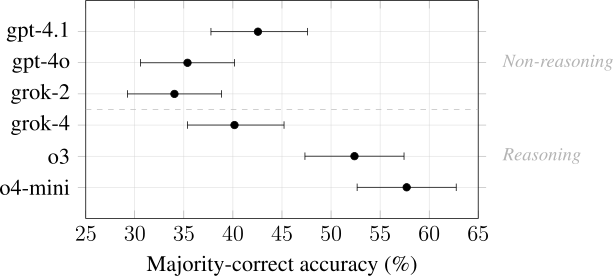
Takeaway All models exhibit high run stability on Required items (consistency \(\approx \)79-85%). Reasoning
models achieve the highest majority-correct item-level solved rates (o4-mini 57.7%, o3 52.4%), while
non-reasoning models range from mid-30s to low-40s. Refusal rates with images are model-dependent
and vary substantially (e.g., grok-4 highest), rather than being uniformly lower for the reasoning family
(Table 3).
Uncertainty We report item-level 95% bootstrap confidence intervals (10k resamples) for
majority-correct accuracy, refusal rate, and item-level consistency in Table 3 and Fig. 3; full details are
in Appendix K. At the family level, we report permutation tests that shuffle model-to-family
assignment (3 vs. 3 models), using items as the unit for the effect statistic; these did not detect reliable
differences in majority-correct solved rate (Reasoning\(-\)Non: \(+12.77\) pp, \(p=0.197\)), with-image refusal (\(+8.63\) pp, \(p=0.298\)), or
item-level consistency (\(-2.30\) pp, \(p=0.400\)).
4.2. Item overlap and robustness (Required, with images)
We next examine how broadly each Required item is solved across models under two robustness
notions: always-correct (3/3 runs) and majority-correct (2/3 or 3/3 runs). Rather than reporting
only run-level accuracy, this view asks: for each item, how many models solve it–none, a
few, or all? The full distribution of “exactly \(k\) models solved” under 3/3 and 2/3+ appears
in Appendix G, Table 19. In brief, the 3/3 criterion concentrates mass toward smaller \(k\)
(stricter robustness), while the 2/3+ criterion shifts mass toward larger \(k\) (more inclusive),
clarifying which items are broadly accessible to current models versus idiosyncratic to specific
models.
4.3. Behavior Without Images on Required
When figures are removed on Required items, we assess calibration by splitting runs into refusal
versus answering (guess-wrong or lucky-correct), and we report item-level consistency (identical
correctness across three runs). Table 5 summarizes run-level counts and percentages for each model
(denominators: \(3\times 376=1{,}128\) runs/model; \(376\) items/model).
Across all six models, refusals dominate: \(1{,}076\)–\(1{,}115\) of \(1{,}128\) runs/model (95.4%–98.9%). Answering is rare:
guess-wrong ranges from \(3\)–\(34\) runs (0.3%–3.0%) and lucky-correct from \(10\)–\(30\) runs (0.9%–2.7%). No-image
behavior is extremely stable: item-level consistency spans \(367\)–\(375\) of \(376\) items (97.6%–99.7%).
Notable differences are small but informative: grok-4 shows the highest refusal rate (1115/1128;
98.9%); o4-mini has the most lucky-correct answers (30/1128; 2.7%); grok-2 produces the
most guess-wrong answers (34/1128; 3.0%); and gpt-4.1 reaches the highest item-level
consistency (375/376; 99.7%). Overall, models are appropriately calibrated to refuse rather than
speculate when critical visuals are missing; small rates of lucky-correct answers remain and are
model-dependent.
Table 5: Required, without images: run-level Count and Percent, plus item-level consistency
(items with identical correctness across three runs). Codes refer to Table 2.
Refusal
Guess-wrong
Lucky-correct
Consistency
Model
Count
Percent
Count
Percent
Count
Percent
Count
Percent
Non-reasoning
gpt-4.1
1102
97.7%
10
0.9%
16
1.4%
375
99.7%
gpt-4o
1092
96.8%
26
2.3%
10
0.9%
373
99.2%
grok-2
1076
95.4%
34
3.0%
18
1.6%
367
97.6%
Reasoning
grok-4
1115
98.9%
3
0.3%
10
0.9%
373
99.2%
o3
1101
97.6%
10
0.9%
17
1.5%
374
99.5%
o4-mini
1084
96.1%
14
1.2%
30
2.7%
374
99.5%
4.4. Cross-Model Agreement
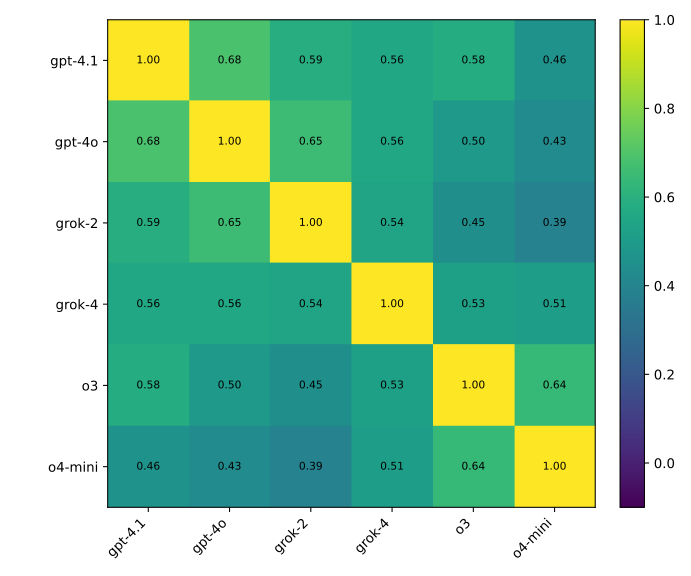
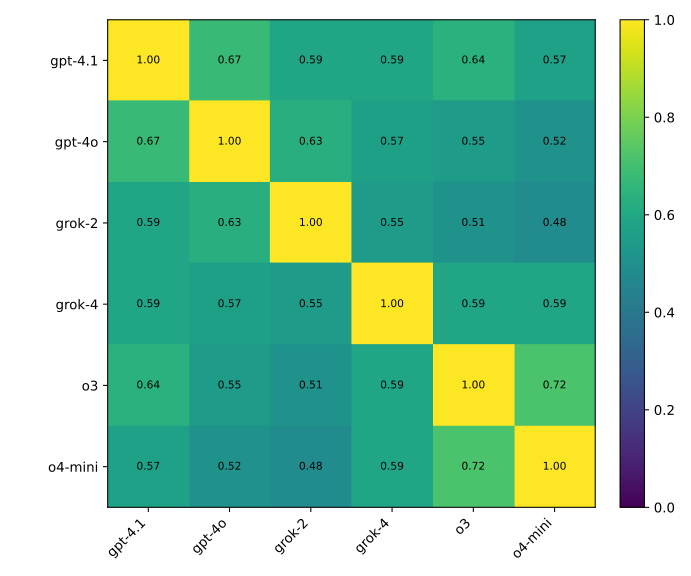
Agreement across the six models shows meaningful within-family coherence and lower agreement
across families; see Table 6 and Fig. 1.
Table 6: Pairwise agreement (Cohen’s \(\kappa \)) on Required, with images. Cells use model codes from
Table 2; values are computed on majority-correct labels (\(\geq \) 2/3 runs).
Model
gpt-4.1
gpt-4o
grok-2
grok-4
o3
o4-mini
gpt-4.1
1.00
0.68
0.59
0.56
0.58
0.46
gpt-4o
0.68
1.00
0.65
0.56
0.50
0.43
grok-2
0.59
0.65
1.00
0.54
0.45
0.39
grok-4
0.56
0.56
0.54
1.00
0.53
0.51
o3
0.58
0.50
0.45
0.53
1.00
0.64
o4-mini
0.46
0.43
0.39
0.51
0.64
1.00
Figure 1: Agreement heatmap on Required items with images (majority-correct labels, \(\geq \) 2/3 runs).
Summary Agreement on which Required items are solvable with images was moderate overall (mean
off-diagonal Cohen’s \(\kappa =0.54\)). Within-family agreement exceeded cross-family: the non-reasoning trio
averaged \(\kappa =0.64\), the reasoning trio \(\kappa =0.56\), while cross-family pairs averaged \(\kappa =0.50\). The most aligned pair was gpt-4.1
vs. gpt-4o (\(\kappa =0.68\)), and the least aligned was grok-2 vs. o4-mini (\(\kappa =0.39\)). We also identify \(76\) Required items
solved by all six models at majority-correct and \(61\) at always-correct (3/3), which we release as
“gold” and “ultra-gold” benchmarks. For coverage context, Table 20 in Appendix G reports
the distribution of items solved by exactly \(k\) models for both criteria (majority-correct and
always-correct).
As a robustness view without chance correction, pairwise Jaccard overlaps on “solved” sets mirror
the pattern (Appendix I): within-family overlaps are high (both families \(\approx 0.63\)) and exceed cross-family (\(\approx 0.55\)),
with the largest raw overlap for o3-o4-mini (\(J\approx 0.72\)).
4.5. Qualitative Error Analysis
We summarize the 83-item contrastive qualitative audit described in Section 3.4.4. Briefly, for each
audited item we code one winner response (from the family that achieves \(\ge 1/3\) correct runs) and one loser
response (from the other family with \(0/3\)), using the merged taxonomy in Table 7; No-error is tracked
separately and not counted as an error. Because the audit set is constructed to isolate family separation,
reported proportions are descriptive of this contrastive set; we include 95% Wilson confidence intervals
for key proportions (Appendix K.1).
Primary outcomes (Table 8) Visual misread was the dominant failure mode when errors occurred,
including cases where the final answer happened to be correct. Because winner responses are
selected from correct attempts by construction, Visual misread in the winner rows indicates
“right answer for the wrong reason”: this occurs in 15/68 (22.1%) of reasoning wins and
8/15 (53.3%) of non-reasoning wins (Table 8). Any response whose steps misinterpreted
the figure was labeled Visual misread regardless of final-answer correctness. In the main
stratum (\(n=68\)), non-reasoning losers were labeled Visual misread in 58/68 (85.3%; 95% CI
[75.0, 91.8]) and refused in 9/68 (13.2%; 95% CI [7.1, 23.3]), while reasoning winners
were labeled Visual misread in 15/68 (22.1%; 95% CI [13.8, 33.3]) and No-error in 52/68
(76.5%; 95% CI [65.1, 85.0]). In the counter-stratum (\(n=15\)), reasoning losers refused in 8/15
(53.3%; 95% CI [30.1, 75.2]) and were labeled Visual misread in 7/15 (46.7%; 95% CI [24.8,
69.9]).
Explanation/format Explanation/format issues were rare in the main stratum and typically
reflected a correct approach expressed in the wrong requested form (e.g., solving for \(x\) when the item
asked for an expression).
Family differences The contrastive design isolates different failure modes by family: when
non-reasoning models fail on items that reasoning models solve (main stratum), their errors are
predominantly Visual misread; conversely, when reasoning models fail on items that non-reasoning
models solve (counter stratum), failures split between refusal and visual misread. When reasoning
succeeds in the main stratum, most responses are No-error with an adequate explanation
(Table 8).
Table 7: Merged qualitative taxonomy used in the audit (three error categories). Each response
receives one primary label; No-error (correct answer with an adequate explanation) is tracked
separately and is not counted as an error.
Correct or near-correct approach, but the
explanation is terse, skips key steps, or is unclear
Correct reasoning in steps,
but wrong final answer due to output format or
misunderstanding of the requested form
Refused
isSolvable=false (model indicates the item
is not solvable under the given inputs).
Table 8: Primary outcome distribution by problem set (merged taxonomy).
Stratum
(family role)
Visual misread
Explanation/format
Refused
No-error
Counter (15)
NON win
8/15 (53.3%)
4/15 (26.7%)
0/15 (0.0%)
3/15 (20.0%)
Counter (15)
REASON lose
7/15 (46.7%)
0/15 (0.0%)
8/15 (53.3%)
0/15 (0.0%)
Main (68)
REASON win
15/68 (22.1%)
1/68 (1.5%)
0/68 (0.0%)
52/68 (76.5%)
Main (68)
NON lose
58/68 (85.3%)
1/68 (1.5%)
9/68 (13.2%)
0/68 (0.0%)
Percentages over total problems in set; each row sums to 100%.
No-error indicates a correct answer with an adequate explanation.
Refused is an explicit decline to solve due to missing information.
NON = non-reasoning model family; REASON = reasoning model family (Table 2).
win/lose indicates whether that family solved the item under our run-level rule; the opposite family did not.
Counter rows are the double-coded counter-stratum (disagreements adjudicated).
Main rows are the single-coded main stratum.
5. DISCUSSION
5.1. Answers to RQ1–RQ3
The quantitative results in Section 4 support three deployment-relevant conclusions: with images,
model behavior is reasonably stable across repeated attempts, with tight uncertainty; when required
figures are removed, models generally avoid speculative answering by refusing; and solvability
judgments vary across models, motivating multi-model robustness views and our released benchmark
subsets. Together, these findings argue for a reliability-first evaluation stance in educational settings:
gate automated feedback and scoring not on single-run accuracy, but on within-model stability and
cross-model corroboration.
5.2. Answer to RQ4 (qualitative patterns)
Across the contrastive audit, the primary family difference is where failures occur in the solution
pipeline. When non-reasoning models fail on items that reasoning models solve, errors are dominated
by Visual misread (Table 8), consistent with the idea that small perceptual or formatting differences
can cascade into downstream symbolic errors (Closser et al., 2024). Reasoning-family
responses show substantially fewer visual misreads in this stratum, aligning with prior evidence that
stronger reasoning supervision can improve grounded, stepwise solutions (Wei et al.,
2022, Kojima et al., 2022).
When non-reasoning models succeed (counter-stratum), residual errors more often reflect
Explanation/format issues (e.g., underspecified steps or responding in the wrong requested form),
which fits concerns about overconfident or incomplete rationales even when the final answer is
correct (Kalai et al., 2025). Overall, the audit suggests a practical interpretation for
tutoring: reasoning models more often clear the perceptual grounding step, while non-reasoning
models’ mistakes more frequently originate in visual evidence extraction; conversely, when either
family succeeds, the remaining gap is often communicative fidelity rather than core computation
(Table 8).
5.3. Accessibility
The refusal-first behavior without images is a desirable safety property for assistive use: systems
should elicit the missing figure (or a structured textual description) rather than speculate, consistent
with guidance on relevance-preserving generative interactions in math tutoring (Levonian
et al., 2025). Our released gold/ultra-gold subsets provide a practical testbed for
accessibility: they are natural candidates for description-substitution experiments comparing original
figures to vetted human (or model-assisted) descriptions while monitoring effects on accuracy, stability,
and refusal.
5.4. Implications for ITS design, scoring, and learner modeling
For ITS deployment, the key question is not only whether a model is accurate, but whether its
behavior is reliable enough to support system design decisions, automated scoring, and learner-model
updates, consistent with prior educational LLM evaluation work that treats predictive consistency as a
key dimension alongside accuracy (Tran et al., 2024). In image-dependent math, this
reliability question is inseparable from visual evidence availability: when an item is Required, a
system must distinguish learner error from missing-figure conditions before assigning credit or
updating mastery. Our Required/Usefullabeling and no-image refusal analysis operationalize this
distinction, providing a practical criterion for when automated scoring and learner-model
updates are valid versus when the system should first elicit the missing visual information.
Our automated correctness pipeline (Appendix E.4) enables scalable solvability estimates,
while run stability and cross-model agreement provide concrete deployment gates; this
mirrors recent findings in automatic evaluation that panel-style corroboration across multiple
LLM judges can improve reliability over single-judge settings (Verga et al.,
2024, Badshah and Sajjad, 2025). For example, high-agreement items (e.g., those solved by \(\geq 5\)
models at majority-correct; Appendix Table 20) are stronger candidates for automated
feedback and downstream learner-model updates, since outcomes are less sensitive to sampling
noise and model idiosyncrasies. Conversely, low-agreement items should trigger guardrails
by design–fallback to human-authored hints, scaffolds that elicit explicit visual-evidence
binding before algebra, or deferral–rather than treating model output as scored evidence. For
deployment, no-image refusals can be treated as missing-context indicators and used to suppress
automated scoring or learner-model updates until the required visual information is provided.
When automated feedback is given, systems should prefer evidence-linked outputs that
make clear what local signals support global judgments (Whitehill and LoCasale-Crouch,
2024).
6. LIMITATIONS
Our study has several limitations worth noting. We evaluated models on a single curriculum, which
may not reflect the full diversity of middle-school math problems across formats, grades, or visual
styles. The models themselves are evolving rapidly.
A related limitation is potential dependence on image type and diagram conventions. The items in
our dataset include multiple visual forms (e.g., Cartesian graphs, geometric figures with conventional
markings, measurement diagrams, and representational models such as tape diagrams). Model
performance may vary substantially across these types–for example, graphs and coordinate
systems require accurate extraction of axes, scale, and plotted points; geometry relies on
conventions such as tick marks, angle arcs, and parallel/perpendicular indicators; and real-world or
schematic diagrams may require interpreting informal pictorial cues. Because we draw from a
single curriculum, diagram styles and conventions are relatively consistent, which may make
evaluation easier than settings where conventions vary across sources. Conversely, results
may not transfer to curricula with different visual encodings, noisier renderings, or more
heterogeneous diagram styles. Stratifying analyses by image type is an important next step for
understanding when and why errors such as Visual misread occur and for designing targeted
mitigations.
A further alternative explanation is potential training-data exposure (data contamination). IM
materials are publicly available, so some item text (and possibly figures) could plausibly appear in
web-scale corpora used to train or tune modern foundation models. If an evaluated model has
memorized an item or a near-duplicate, it could produce a correct answer in the no-image condition
without actually inferring missing visual information, inflating estimates of without-image
solvability or “lucky-correct” behavior. This concern is consistent with evidence that some
apparent mathematical “reasoning” in LLMs can be brittle under controlled perturbations
(e.g., changing only numeric values) (Mirzadeh et al., 2025). Our design
partially mitigates this concern by comparing with-image versus no-image behavior on the
same prompt text and by manually auditing Required-labeled items that achieved any
no-image correctness in the refinement pass (Appendix C), retaining items as Requiredwhen
without-image success required assumptions or ambiguous inference. Nonetheless, we do not
claim to fully rule out contamination, and dedicated checks (e.g., near-duplicate detection,
paraphrase-based re-evaluation, or evaluation on newly authored items) remain important future
work.
Image-role labeling necessarily involves judgment. The full 541-item labeling was produced by a
single rater using a frozen operational codebook; to assess reliability, we conducted an independent
second-rater audit on a stratified subset of 153 items and report chance-corrected agreement for both
the four-way taxonomy and the Requiredvs. non-Requiredboundary (Appendix D). Consistent
with prior observations that “usefulness” is more subjective, disagreements in the audit concentrated in
the Usefulvs. Not Requireddistinction, while agreement on the high-stakes Requiredboundary
was stronger.
To further reduce accidental over-labeling of Required, we performed a conservative
flag-then-review refinement pass focused only on Required-labeled items, using no-image
correctness under our prompt and scoring protocol only as a screening signal and adjudicating all final
decisions against the operational definitions (Appendix C). This step strengthens confidence that
items retained as Requiredcontain task-critical information that is not recoverable from
text alone without adding assumptions, but it may miss other boundary cases that different
models, prompts, or scoring rules would surface; this dependence is likely conservative in
that it tends to retain borderline items as Requiredrather than incorrectly downgrading
them.
The qualitative audit, though focused and revealing, covered only 83 problems (a contrastive subset
where the two model families separate under our run-level rule). Accordingly, we treat these codes as
mechanism-finding and hypothesis-generating rather than statistically powered evidence for
family-wide prevalence claims; scaling qualitative labeling to much larger item sets (e.g., with
validated automated or LLM-assisted coding protocols) is an important direction for future work. We
merged fine-grained visual errors (e.g., misreading axes vs. diagram relations) into a single Visual
misread category due to rater disagreement–a necessary trade-off for reliability, but one
that obscures nuance. The original 7-category taxonomy is provided in Appendix L for
transparency.
We did not include a human baseline–neither student nor teacher performance–so we cannot say
how LLMs compare to learners in perception or explanation clarity. Nor did we explore alt-text
generation, scaffolding prompts, or human-LLM collaboration, all promising directions for real-world
tutoring.
A further limitation is that we do not analyze which textual cues in an item (e.g., explicit figure
references such as “as shown in the diagram”) predict refusal versus guessing in the without-image
condition. The released item-level artifacts enable such analyses.
Finally, agreement metrics could be defined differently–for example, over non-refusal attempts or as
a three-way code (correct/wrong/refusal). We chose correctness as the primary signal for pedagogical
utility and report refusal separately (RQ2), but alternative definitions remain valuable robustness
checks.
7. FUTURE WORK
Our findings highlight the superior visual perception and explanation clarity of reasoning models,
alongside persistent gaps in non-reasoning models. To build on these insights and move
toward practical, learner-facing systems, we outline several promising directions for future
exploration.
A natural next step is to strengthen image-role labeling through multi-rater coding. A concise
codebook could be applied by several raters, with agreement metrics and adjudication protocols
reported. Re-running analyses on a consensus set, with sensitivity to labeling thresholds, would help
assess the robustness of our Required classification.
To broaden generalizability, we plan to expand the corpus beyond Grades 6-8, while tagging items
by figure type (e.g., graphs, diagrams, tables) and visual complexity. This would support
strand-level analyses and difficulty modeling (e.g., using Rasch/IRT), treating model runs as
responses.
For accessibility, the gold and ultra-gold benchmarks–items solved with images and responsibly
refused without–offer an ideal testbed for textual description substitution. Randomized comparisons of
vetted human descriptions versus original figures could measure effects on accuracy, stability, and
refusal rates, with input from blind or low-vision users. A follow-up might explore whether
model-generated alt text approaches human quality.
Explanation quality also merits deeper study. A teacher-developed rubric could score clarity, step
coverage, and warranting in model rationales, correlating these with correctness and refusal behavior.
This would clarify whether reasoning models truly excel pedagogically–or merely appear to–and
whether scaffolds enhance clarity.
Finally, real-world pilots in intelligent tutoring systems remain a key goal: routing visual items to
vetted models, inserting safety prompts when images are missing, and logging learner outcomes (e.g.,
hint needs, time-to-correct, refusal frequency). Ethical audits for hallucinated visual details and harmful
failures would accompany deployment.
8. CONCLUSION
This paper examined whether contemporary MLLMs can solve middle-school mathematics
problems whose figures carry essential information, and whether they behave responsibly when those
figures are absent. Using six models (three reasoning: grok-4, o3, o4-mini; three non-reasoning:
gpt-4.1, gpt-4o, grok-2-vision), three runs per item in with-image and without-image conditions, and a
conservative reclassification of image roles, we focused analyses on a final Requiredset of 376
items.
With images present, models showed non-trivial competence and high run stability across repeated
attempts. Under our primary item-level metric (majority-correct, \(\geq \)2/3 runs), the strongest reasoning
models achieved the highest solved rates (o4-mini 57.7%, o3 52.4%), while non-reasoning models
ranged from the mid-30s to low-40s. Without images, models overwhelmingly refused (\(\approx \)95–99%)
rather than guessing, with only rare lucky-correct answers (\(\le \)3%). Agreement on which items
are solvable with images was moderate overall (mean Cohen’s \(\kappa \approx 0.54\)), with higher cross-model
agreement within families than across families. We identified 76 items solved by all six models at
majority-correct and 61 items solved 3/3 by all six, which we release as gold and ultra-gold
benchmarks.
In a contrastive qualitative audit of 83 Requireditems (the exhaustive subset where the reasoning
and non-reasoning families separate under our run-level criterion), visual misreading was the dominant
failure mode. In the main stratum (reasoning succeeds; non-reasoning fails), non-reasoning loser
responses were labeled Visual misread in 58/68 cases (85.3%), while reasoning winner responses were
usually No-error (52/68; 76.5%) but still sometimes exhibited “right answer for the wrong reason”
visual misreads (15/68; 22.1%). Explanation/format issues were rare in the main stratum, and were
more evident among non-reasoning winner responses in the counter-stratum (4/15; 26.7%)
(Table 8).
These findings have two immediate implications. For tutoring systems, image-role awareness
should gate automated scoring and learner-model updates: when an item is Required, no-image
refusals should be treated as missing-context signals rather than learner error, and with-image support
should prioritize approaches that enforce explicit visual-evidence binding before algebra.
For accessibility, the gold/ultra-gold benchmarks provide a principled starting point for
description-substitution studies that test when structured textual descriptions can replace figures
without degrading accuracy, stability, or refusal behavior.
Our study has limitations, including a single curricular source, evolving model versions, image-role
labels that begin with a single rater (mitigated via an independent audit and a conservative refinement
pass), and a focused contrastive qualitative audit. We did not evaluate alt-text generation, scaffolding
prompts, or human–LLM collaboration.
We release code, prompts, summary tables, and the gold/ultra-gold benchmarks to support
replication. Future work will strengthen multi-rater image-role reliability, stratify findings by figure
type and visual complexity, test lightweight scaffolds targeting visual misreads and evidence binding,
broaden coverage across grades and item types, and run accessibility studies comparing original figures
to vetted textual descriptions. Together, these steps can turn measured competence on image-dependent
items into more robust, learner-facing support.
ACKNOWLEDGMENTS
We would like to thank NSF (e.g., 2118725, 2118904, 1950683, 1917808, 1931523, 1940236,
1917713, 1903304, 1822830, 1759229, 1724889, 1636782, & 1535428), IES (e.g., R305N210049,
R305D210031, R305A170137, R305A170243, R305A180401, & R305A120125), GAANN (e.g.,
P200A180088 & P200A150306), EIR (U411B190024 & S411B210024), ONR (N00014-18-1-2768),
NIH (R44GM146483), and Schmidt Futures. None of the opinions expressed here are those of the
funders.
DECLARATION OF GENERATIVE AI SOFTWARE TOOLS IN THE WRITINGPROCESS
During the preparation of this work, the author(s) used Grok 4 (xAI) in the Qualitative Error
Analysis (RQ4) section in order to iteratively refine the coding taxonomy, compute inter-rater
reliability, interpret confusion matrices, and draft narrative interpretations of error patterns. The tool
was also used to streamline and polish the Limitations and Future Work sections for clarity and flow.
After using this tool, the author(s) reviewed and edited all content, verified all statistical claims and
percentages against raw script output, and take full responsibility for the content of the
publication.
REFERENCES
Ainsworth, S. 2006. Deft: A conceptual framework for considering learning with multiple
representations. Learning and Instruction16, 3, 183–198.
Anderson, J. R., Corbett, A. T., Koedinger, K. R., and Pelletier, R. 1995. Cognitive
tutors: Lessons learned. The Journal of the Learning Sciences4, 2, 167–207.
Arneson, J. B. and Offerdahl, E. G. 2018. Visual literacy in Bloom: Using Bloom’s taxonomy
to support visual learning skills. CBE–Life Sciences Education17, 1 (Mar), ar7.
ASSETS 2025 Organizing Committee. 2025. Accessibility guidelines. ACM SIGACCESS
Conference on Computers and Accessibility. Accessed October 26, 2025.
Badshah, S. and Sajjad, H. 2025. Reference-guided verdict: LLMs-as-judges in automatic
evaluation of free-form QA. In Proceedings of the 9th Widening NLP Workshop, C. Zhang,
E. Allaway, H. Shen, L. Miculicich, Y. Li, M. M’hamdi, P. Limkonchotiwat, R. H. Bai,
S. T.y.s.s., S. S. Han, S. Thapa, and W. B. Rim, Eds. Association for Computational Linguistics,
Suzhou, China, 251–267.
Benetech. 2019. Specific guidelines – mathematics.http://diagramcenter.org/specific-guidelines-g.html. DIAGRAM Center,
supported by the U.S. Department of Education, Office of Special Education Programs (Cooperative
Agreement #H327B100001). Accessed October 26, 2025.
Braille Authority of North America (BANA). 2022. Guidelines and standards for tactile
graphics. ISBN (print): 979-8-9883302-0-2; ISBN (braille): 979-8-9883302-1-9.
Chawla, N. V., Bowyer, K. W., Hall, L. O., and Kegelmeyer, W. P. 2002. SMOTE:
synthetic minority over-sampling technique. Journal of Artificial Intelligence Research16, 321–357.
Chen, F., Yuan, H., Xu, Y., Feng, T., Cen, J., Liu, P., Huang, Z., and Yang, Y. 2025. MathFlow:
Enhancing the perceptual flow of MLLMs for visual mathematical problems. arXiv preprint
arXiv:2503.16549. Code available at https://github.com/MathFlow-zju/MathFlow.
Chen, Z., Hu, W., He, G., Deng, Z., Zhang, Z., and Hong, R. 2025. Unveiling uncertainty: A
deep dive into calibration and performance of multimodal large language models. In Proceedings
of the 31st International Conference on Computational Linguistics. Association for Computational
Linguistics, Abu Dhabi, UAE, 3095–3109.
Closser, A. H., Botelho, A., Chan, J., etal. 2024. Exploring the impact of symbol spacing and
problem sequencing on arithmetic performance: An educational data mining approach. Journal of
Educational Data Mining16, 1, 84–111.
Cobbe, K., Kosaraju, V., Bavarian, M., Chen, M., Jun, H., Kaiser, L., Plappert, M.,
Tworek, J., Hilton, J., Nakano, R., Hesse, C., and Schulman, J. 2021. Training verifiers
to solve math word problems. arXiv preprint arXiv:2110.14168.
Cohen, J. 1960. A coefficient of agreement for nominal scales. Educational and Psychological
Measurement20, 1, 37–46.
Corbett, A. T. and Anderson, J. R. 1994. Knowledge tracing: Modeling the acquisition of
procedural knowledge. User Modeling and User-Adapted Interaction4, 4, 253–278.
Eagan, B., Brohinsky, J., Wang, J., and Shaffer, D. W. 2020. Testing the reliability of
inter-rater reliability. In Proceedings of the Tenth International Conference on Learning Analytics &
Knowledge. LAK ’20. Association for Computing Machinery, New York, NY, USA, 454–461.
Evagorou, M., Erduran, S., and Mäntylä, T. 2015. The role of visual representations in scientific
practices: From conceptual understanding and knowledge generation to ’seeing’ how science works.
International Journal of STEM Education2, 11 (July), 11.
Feng, J., Wang, Z., Zhang, Z., Guo, Y., Zhou, Z., Chen, X., Li, Z., and Yin, D.2025. MathReal: We keep it real! A real scene benchmark for evaluating math reasoning
in multimodal large language models. arXiv preprint arXiv:2508.06009. Code available athttps://github.com/junfeng0288/MathReal.
Heffernan, N. T. and Heffernan, C. L. 2014. The ASSISTments ecosystem: Building a platform
that brings scientists and teachers together for minimally invasive research on human learning and
teaching. International Journal of Artificial Intelligence in Education24, 4, 470–497.
Hwang, H., Kim, D., Kim, S., Ye, S., and Seo, M. 2024. Self-explore: Enhancing mathematical
reasoning in language models with fine-grained rewards. In Findings of the Association for
Computational Linguistics: EMNLP 2024, Y. Al-Onaizan, M. Bansal, and Y.-N. Chen, Eds.
Association for Computational Linguistics, Miami, Florida, USA, 1444–1466.
Ji, H., Qiu, S., Xin, S., Han, S., Chen, Z., Zhang, D., Wang, H., and Yao, H. 2025.
From EduVisBench to EduVisAgent: A benchmark and multi-agent framework for reasoning-driven
pedagogical visualization. In The 5th Workshop on Mathematical Reasoning and AI at NeurIPS 2025.
NeurIPS, NeurIPS, Online.
Jiang, Z., Peng, H., Feng, S., Li, F., and Li, D. 2024. LLMs can find mathematical reasoning
mistakes by pedagogical chain-of-thought. In Proceedings of the Thirty-Third International Joint
Conference on Artificial Intelligence, IJCAI-24, K. Larson, Ed. International Joint Conferences on
Artificial Intelligence Organization, Jeju Island, South Korea, 3439–3447. Main Track.
Kadavath, S., Conerly, T., Askell, A., El-Showk, S., Schiefer, N., Nadler, K., Ladd, A.,
Ganguli, D., Henighan, T., Jones, A., Bowman, N., Kravec, A., Lovitt, Z., Ndousse,K., Chen, A., Kapadia, T., Amodei, D., Hernandez, D., Drain, D., Ganguli, S., Clark,J., and Kaplan, J. 2022. Language models (mostly) know what they know. arXiv preprint
arXiv:2207.05221.
Kalai, A. T., Nachum, O., Vempala, S. S., and Zhang, E. 2025. Why language models
hallucinate. arXiv preprint arXiv:2509.04664.
Koedinger, K. R. and Corbett, A. T. 2006. Cognitive tutors: Technology bringing learning
science to the classroom. In The Cambridge Handbook of the Learning Sciences, R. K. Sawyer, Ed.
Cambridge University Press, New York, NY, 61–77.
Kojima, T., Gu, S. S., Reid, M., Matsuo, Y., and Iwasawa, Y. 2022. Large language models are
zero-shot reasoners. Advances in Neural Information Processing Systems35, 22199–22213.
Krippendorff, K. 2011. Computing Krippendorff’s Alpha-Reliability. Working Paper 43, University
of Pennsylvania, Annenberg School for Communication, Philadelphia, PA. Jan. Postprint version.
Larkin, J. H. and Simon, H. A. 1987. Why a diagram is (sometimes) worth ten thousand words.
Cognitive Science11, 1, 65–100.
Levonian, Z., Henkel, O., Li, C., and Postle, M.-E. 2025. Designing safe and relevant generative
chats for math learning in intelligent tutoring systems. Journal of Educational Data Mining17, 1,
66–97.
Li, C., Liu, Y., Zhang, T., Wang, M., and Huang, H.2026. VisioMath: Benchmarking figure-based mathematical reasoning in LMMs. ICLR 2026 Poster,
OpenReview. https://openreview.net/forum?id=31pzK2VSQQ.
Lu, P., Bansal, H., Xia, T., Liu, J., Li, C., Hajishirzi, H., Cheng, H., Chang, K.-W.,
Galley, M., and Gao, J. 2024. MathVista: Evaluating mathematical reasoning of foundation
models in visual contexts. In The Twelfth International Conference on Learning Representations.
OpenReview.net, Vienna, Austria.
Marriott, K., Lee, B., Butler, M., Cutrell, E., Ellis, K., Goncu, C., Hearst, M., McCoy,K., and Szafir, D. A. 2021. Inclusive data visualization for people with disabilities: A call to
action. Interactions28, 3 (Apr.), 47-51.
Mathematics, I. 2019. Illustrative mathematics, grade 6-8. Available athttps://illustrativemathematics.org/. Authored by Illustrative Mathematics.
Mayer, R. E. 2020. Multimedia Learning, 3rd ed. Cambridge University Press, Cambridge, UK.
Mirzadeh, S. I., Alizadeh, K., Shahrokhi, H., Tuzel, O., Bengio, S., and Farajtabar, M.2025. GSM-Symbolic: Understanding the limitations of mathematical reasoning in large language
models. In The Thirteenth International Conference on Learning Representations. OpenReview.net,
Singapore.
Nobre, C., Zhu, K., Mörth, E., Pfister, H., and Beyer, J. 2024. Reading between the pixels:
Investigating the barriers to visualization literacy. In Proceedings of the 2024 CHI Conference on
Human Factors in Computing Systems. CHI ’24. Association for Computing Machinery, New York,
NY, USA.
Nye, M., Andreassen, A. J., Gur-Ari, G., Michalewski, H., Austin, J., Bieber, D.,
Dohan, D., Lewkowycz, A., Bosma, M., Luan, D., Sutton, C., and Odena, A. 2021.
Show your work: Scratchpads for intermediate computation with language models. arXiv preprint
arXiv:2112.00114.
Ouyang, L., Wu, J., Jiang, X., Almeida, D., Wainwright, C., Mishkin, P., Zhang, C.,
Agarwal, S., Slama, K., Ray, A., etal. 2022. Training language models to follow instructions
with human feedback. Advances in Neural Information Processing Systems35, 27730–27744.
Pelánek, R. 2017. Bayesian knowledge tracing, logistic models, and beyond: An overview of learner
modeling techniques. User Modeling and User-Adapted Interaction27, 3, 313–350.
Roschelle, J., Feng, M., Murphy, R. F., and Mason, C. A. 2016. Online mathematics
homework increases student achievement. AERA Open2, 4, 1–12.
Rudman, W., Golovanevsky, M., Bar, A., Palit, V., LeCun, Y., Eickhoff, C., and Singh,R. 2025. Forgotten polygons: Multimodal large language models are shape-blind. In Findings of the
Association for Computational Linguistics: ACL 2025, W. Che, J. Nabende, E. Shutova, and M. T.
Pilehvar, Eds. Association for Computational Linguistics, Vienna, Austria, 11983–11998.
Selent, D., Patikorn, T., and Heffernan, N. T. 2016. ASSISTments dataset from multiple
randomized controlled experiments. In Proceedings of the Third (2016) ACM Conference on Learning
@ Scale. L@S ’16. Association for Computing Machinery, Edinburgh, Scotland, UK, 181–184.
Shi, W., Hu, Z., Bin, Y., Liu, J., Yang, Y., Ng, S.-K., Bing, L., and Lee, R. K.-W.2024. Math-LLaVA: Bootstrapping mathematical reasoning for multimodal large language models.
In Findings of the Association for Computational Linguistics: EMNLP 2024. Association for
Computational Linguistics, Miami, Florida, USA, 4663–4680.
Shi, Y., Liang, R., and Xu, Y. 2025. EducationQ: Evaluating LLMs’ teaching capabilities through
multi-agent dialogue framework. In Proceedings of the 63rd Annual Meeting of the Association for
Computational Linguistics (Volume 1: Long Papers), W. Che, J. Nabende, E. Shutova, and M. T.
Pilehvar, Eds. Association for Computational Linguistics, Vienna, Austria, 32799–32828.
Sun, Y., Zhang, S., Tang, W., Chen, A., Koniusz, P., Zou, K., Xue, Y., and vanden Hengel,A. 2026. Math blind: Failures in diagram understanding undermine reasoning in MLLMs. ICLR 2026
Poster, OpenReview. https://openreview.net/forum?id=RtvmTxdQV9.
Sweller, J., van Merriënboer, J. J. G., and Paas, F. G. W. C. 1998. Cognitive architecture
and instructional design. Educational Psychology Review10, 3, 251–296.
Sáez, A. I., Rhomrasi, L., Ahsini, Y., Vinuesa, R., Hoyas, S., Sabater, J. P. G.,
i Alfonso, M. J. F., and Conejero, J. A. 2025. Evaluating visual mathematics in multimodal
LLMs: A multilingual benchmark based on the kangaroo tests. arXiv preprint arXiv:2506.07418.
Tang, L., Kim, G., Zhao, X., Lake, T., Ding, W., Yin, F., Singhal, P., Wadhwa, M., Liu,Z. L., Sprague, Z., Namuduri, R., Hu, B., Rodriguez, J. D., Peng, P., and Durrett,G. 2025. ChartMuseum: Testing visual reasoning capabilities of large vision-language models. In
Advances in Neural Information Processing Systems 38. Curran Associates, Inc., San Diego, CA.
Tran, N., Pierce, B., Litman, D., Correnti, R., Matsumura, L. C., etal. 2024.
Multi-dimensional performance analysis of large language models for classroom discussion
assessment. Journal of Educational Data Mining16, 2, 304–335.
Trewin, S. 2019. Describing figures. SIGACCESS Resources. Accessed October 26, 2025.
VanLehn, K. 2006. The behavior of tutoring systems. International Journal of Artificial Intelligence in
Education16, 3, 227–265.
VanLehn, K. 2011. The relative effectiveness of human tutoring, intelligent tutoring systems, and other
tutoring systems. Educational Psychologist46, 4, 197–221.
Verga, P., Hofstätter, S., Althammer, S., Su, Y., Piktus, A., Arkhangorodsky, A., Xu,M., White, N., and Lewis, P. 2024. Replacing judges with juries: Evaluating LLM generations
with a panel of diverse models. arXiv preprint arXiv:2404.18796.
W3C Accessibility Guidelines Working Group. 2024. Web content accessibility guidelines
(wcag) 2.2. W3C Recommendation. Latest version: https://www.w3.org/TR/WCAG22/.
Wang, P., Li, Z.-Z., Yin, F., Ran, D., and Liu, C.-L. 2025. MV-MATH: Evaluating multimodal
math reasoning in multi-visual contexts. In Proceedings of the IEEE/CVF Conference on Computer
Vision and Pattern Recognition (CVPR). IEEE, Nashville, TN, USA, 19541–19551.
Wei, J., Wang, X., Schuurmans, D., Bosma, M., Ichter, B., Xia, F., Chi, E. H., Le, Q. V.,
and Zhou, D. 2022. Chain-of-thought prompting elicits reasoning in large language models. In
Advances in Neural Information Processing Systems 35. Curran Associates, Inc., New Orleans,
Louisiana, USA.
Whitehill, J. and LoCasale-Crouch, J. 2024. Automated evaluation of classroom instructional
support with LLMs and bows: Connecting global predictions to specific feedback. Journal of
Educational Data Mining16, 1, 34–60.
Woolf, B. P. 2008. Building Intelligent Interactive Tutors: Student-Centered Strategies for
Revolutionizing E-Learning. Morgan Kaufmann, San Francisco, CA.
Xia, S., Li, X., Liu, Y., Wu, T., and Liu, P. 2025. Evaluating mathematical reasoning beyond
accuracy. Proceedings of the AAAI Conference on Artificial Intelligence39, 26, 27723–27730.
Yan, Y., Su, J., He, J., Fu, F., Zheng, X., Lyu, Y., Wang, K., Wang, S., Wen, Q., and Hu,X. 2025. A survey of mathematical reasoning in the era of multimodal large language model:
Benchmark, method & challenges. In Findings of the Association for Computational Linguistics: ACL
2025. Association for Computational Linguistics, Vienna, Austria, 11798–11827.
Yan, Y., Wang, S., Huo, J., Li, H., Li, B., Su, J., Gao, X., Zhang, Y.-F., Xu, T., Chu, Z., Zhong,A., Wang, K., Xiong, H., Yu, P. S., Hu, X., and Wen, Q. 2024. ErrorRadar: Benchmarking
complex mathematical reasoning of multimodal large language models via error detection. Submitted
to ICLR 2025; OpenReview: https://openreview.net/forum?id=GeTBk67mK6.
Yang, Z., Li, L., Lin, K., Wang, J., Lin, C.-C., Liu, Z., and Wang, L. 2023. The dawn of LMMs:
Preliminary explorations with GPT-4V(ision). arXiv preprint arXiv:2309.17421.
Yin, S., Fu, C., Zhao, S., Li, K., Sun, X., Xu, T., and Chen, E. 2024. A survey on multimodal
large language models. National Science Review11, 12 (Nov.), nwae403.
Yin, Z., Sun, Y., Huang, X., Qiu, X., and Zhao, H. 2025. Error classification of large language
models on math word problems: A dynamically adaptive framework. In Findings of the Association
for Computational Linguistics: EMNLP 2025. Association for Computational Linguistics, Suzhou,
China, 338–365.
Zhang, L. and Graf, E. A. 2025. Mathematical computation and reasoning errors by large language
models. In Proceedings of the Artificial Intelligence in Measurement and Education Conference
(AIME-Con): Full Papers. Vol. 2025.aimecon-main. National Council on Measurement in Education
(NCME), Pittsburgh, Pennsylvania, United States, 417–424.
Zhang, R., Jiang, D., Zhang, Y., Lin, H., Guo, Z., Qiu, P., Zhou, A., Lu, P., Chang, K.-W.,
Qiao, Y., etal. 2024. MATHVERSE: Does your multi-modal LLM truly see the diagrams in
visual math problems? In European Conference on Computer Vision. Springer Nature Switzerland,
Cham, 169–186.
A. IMAGE-ROLE EXEMPLARS
Table 9: Image-role exemplars, with item GUIDs included for traceability.
Required: Task-critical information
appears only in the image.
Item ID:3b119229-571b-4dfc-be97-d88c62a41a11
Useful: Text sufficient; image
clarifies/disambiguates.
Item ID:621e3968-48d9-44a7-a36c-c120e25682bd
Find the area of the shaded region(s) of the
figure.
A rectangular prism is 3 units high, 2 units
wide, and 5 units long. What is its surface
area in square units?
____ cm2
____ square units
Not Required: Decorative / no
task-relevant support.
Item ID:d7b5f135-04ff-419b-a005-cf6e4a7d5851
Insufficient: Missing information prevents
a unique answer.
Item ID:0f88aaba-bb92-4b0f-9252-b104f81ba8fb
Neon bracelets cost $1 for 4. What is the
cost per bracelet?
What is the distance between B and D?
$_________
____ units
B. MODEL-RESPONSE EXEMPLARS
Note. Exemplars are abridged for readability. Each table shows (left) the item stem, item GUID, and
figure, and (right) two response excerpts (one non-reasoning and one reasoning) selected from the
contrastive audit described in Section 3. Excerpts follow the requested JSON schema (showing
isSolvable, a minimal step summary, and the extracted answer.value/answer.units). The
qualitative label shown is the paper’s primary merged code for that response (Table 7); we do not
re-adjudicate codes based on excerpted details. The ✓/✗indicator denotes whether the extracted
final answer matches the reference answer under our automated equivalence procedure
(Appendix E.4).
Table 10: Model-response exemplar 1 (paired; area from grid). Both responses apply the
correct area formula, but the reasoning-family response misreads the figure’s height, producing
an incorrect final answer (✗).
Problem (with image)
Model response excerpt (JSON schema)
Item: 298a3eb5-21fb-4923-b7
df-2cd6200d9ec
Stem: Find the area of the
parallelogram.
Gold (answer): 15
Non-reasoning (gpt-4o; Attempt 1) — No-error
✓isSolvable: true Step 1: Base length is 3 units. Step 2: Height is 5 units. Step 3: Area = base \(\times \) height. answer.value: 15 answer.units: square units
✗isSolvable: true Step 1: Base spans 3 squares. Step 2: Height spans 7 squares. Step 3: Area = base \(\times \) height. answer.value: 21 answer.units: square units
Table 11: Model-response exemplar 2 (paired; correctness vs. explanation fidelity). The
non-reasoning response attains the correct final answer (✓) but is coded Explanation/format
because its stated visual grounding is inconsistent with the figure; the reasoning-family response
misreads the diagram and yields an incorrect value (✗).
✓isSolvable: true Step 1: Identify triangle vertices
from the grid. Step 2: Use a coordinate-based
triangle area formula. Step 3: Substitute and simplify. answer.value: 6 answer.units: square units
✗isSolvable: true Step 1: Identify triangle vertices
from the grid. Step 2: Treat as a right triangle
using base/height from the grid. Step 3: Area \(=\tfrac 12 bh\). answer.value: 7.5 answer.units: square units
Table 12: Model-response exemplar 3 (paired; axes/interval selection). The non-reasoning
response selects the wrong interval on the graph and computes an incorrect rate (✗); the
reasoning-family response selects the correct decreasing interval and computes the correct rate
magnitude (✓).
Problem (with image)
Model response excerpt (JSON schema)
Item: 2a668c96-77b3-4c2c-b1
99-8396f2f13372
Stem: Determine the phone battery
discharge rate during the interval
where it is decreasing.
✓isSolvable: true Step 1: Use interval 2-4 hours after
noon (100% to 40%). Step 2: Change \(=40-100=-60\), duration \(=2\). Step 3: Rate \(=(-60)/2=-30\), magnitude 30 per hour. answer.value: 30 answer.units: % per hour
Table 13: Model-response exemplar 4 (without-image; RQ2). Under image removal, one
model proceeds as if the task were a plain rectangle-perimeter computation (incorrect), whereas
another model refuses and requests the missing visual information. The figure is shown here
for reader context but was withheld from the models in the without-image condition. Markers:
✓ correct final answer; ✗ incorrect final answer; \(\relax \oslash \) refusal (isSolvable=false).
Problem (without-image condition)
Model response excerpt (JSON schema)
Item: b65e19a7-b903-478c-af
5a-a0aab98f689a
Problem ID: PRBE4YB
Stem: Kiran bent some wire around a
rectangle to make a picture frame (8
in by 10 in). Find the perimeter of the
wire picture frame (nearest tenth).
Gold (answer): 62.8
Condition: without-image (models did
not receive the figure).
✗isSolvable: true Step 1: Use rectangle dimensions 10
and 8. Step 2: Perimeter \(=2(10+8)=36\). Step 3: Round to nearest tenth. answer.value: 36.0 answer.units: inches
grok-4-0709 (Attempt 3) — Refused (no-image)
\(\relax \oslash \)isSolvable: false required_information: [need the figure
/ a description of the wire path] answer: null
C. REfiNEMENT AUDIT TRAIL (Required\(\rightarrow \) Useful)
C.1. Audit-set composition for inter-rater reliability
The stratified IRR audit set (\(n=153\)) included all items labeled Not Required(\(n=26\)) and Insufficient(\(n=17\)),
all refinement-boundary items (the six items downgraded Required\(\rightarrow \)Usefuland the 14 items flagged
for review but retained as Required), and additional seeded random samples of Requiredand
Usefulitems to reach targets of 70 and 40, respectively.
C.2. Screening signal
To audit potential over-labeling of Requireditems, we manually reviewed every Required-labeled
item that received at least one correct answer in the no-image condition (i.e., the model answered
correctly despite the figure being withheld). No-image correctness was used only to prioritize items for
inspection; it was not used as a decision rule for re-labeling. Each flagged item was adjudicated against
the operational definitions of image role: if the text alone fully specified a unique solution without
introducing additional assumptions, the item was downgraded Required\(\rightarrow \)Useful; otherwise it
remained Requiredand was recorded as assumption/ambiguity-driven without-image
success.
In the initial screening (using gpt-4o and grok-2), 17 items were flagged; 6 were downgraded and
11 were retained as Requireddue to without-image ambiguity. After solving with all six models,
three additional items were flagged (correct in no-image only by reasoning models); manual inspection
retained all three as Required.
Table 14: Items downgraded from Requiredto Usefulafter manual inspection. No-image
correctness served only as a screening signal to prioritize inspection; downgrade decisions
required that the text alone support a unique solution without extra assumptions.
Item GUID
Manual adjudication (without-image; no assumptions)
abdfafc7-9963-402e-945f-77ea3e6e2dbe
All needed quantities are stated in text (1146 in\(^2\), 10 in, 14 bags); compute \((1146\cdot 10)/14 \approx 819\) in\(^3\).
254bf2a3-5b60-4b66-8870-f2b6ee9aaa8b
Andre’s savings are fully specified in text ($15 initial, $5/week); equation \(y=5x+15\);
Noah’s graph not required.
b0c42988-6a6a-4cb0-b206-19e6beda4c44
Given diameter \(d=2\) cm, radius \(r=d/2=1\) cm; the graph/context is irrelevant to this
subquestion.
7c0ce88e-a06a-488e-9dca-31ce626792ea
A dilation about \(B\) maps \(H\) to itself only with identity scale factor \(k=1\) (for \(H\neq B\)); no
measurements required.
6d57b7ce-512d-4d09-8234-cc119b87429a
Two points are given in text, \((0,2)\) and \((4,1)\); the line through them is \(y=-\tfrac 14x+2\); no image-based
information needed.
c4949d14-d7ab-4d3d-ac27-44dc709a710b
Volume \(V=A h\); doubling \(h\) doubles \(V\) for any base area \(A\), so percent increase is \(100\%\).
Table 15: Items flagged for review due to at least one correct no-image run (initially on
gpt-4o/grok-2, and again after adding four more models), but retained as Requiredafter
manual inspection because without-image success depended on assumptions, ambiguous diagram
interpretation, or unstated scale/structure.
Route-geometry inference: segments treated as straight and arranged as shown.
4816db56-78f0-40b4-bcf7-23e067ed6964
Shape classification inference (rectangle interpreted as non-square).
dd1cafca-786f-4dca-b816-74fe3762c4e6
Grid-structure inference: cube face interpreted as a \(3\times 3\) grid.
18b5ee97-7592-4e7e-b8bc-4e824033ebe3
Tick-mark count/spacing inference between 6 and 15.
1673fe10-8161-4479-9d0c-3df4ba9f55cb
Box-plot structure inference: assumes 0.5 and 1 are Q1 and Q3 (the box).
96c844c5-ef04-4945-82c5-5e4fb5047cae
Diagram-dependent configuration; overlap area non-unique from text alone.
47f829d6-62ce-4880-9182-f35006db5acf
Angle-label inference: \(b\) treated as \(m\angle ABC\), with \(DE\parallel AC\).
D. INTER-RATER RELIABILITY FOR IMAGE-ROLE LABELS
We report confusion matrices and chance-corrected agreement (Cohen’s \(\kappa \)) for the independent
image-role labels on the 153-item IRR audit set (Section 3). We additionally report 95%
bootstrap confidence intervals (items resampled with replacement; \(B=5000\); seed=123). Across
the four labels (Required, Useful, Not Required, Insufficient), agreement was
71.9% (110/153) with \(\kappa =0.591\) (95% CI [0.492, 0.687]). When collapsing to a binary boundary
(Requiredvs. non-Required), agreement was 88.2% (135/153) with \(\kappa =0.764\) (95% CI [0.657,
0.865]).
Table 16: Confusion matrix for four-way image-role labels on the 153-item IRR audit set (rows:
independent rater; columns: first author).
Rater 2 (first author)
Rater 1
Required
Useful
Not Required
Insufficient
Required
62
5
0
5
Useful
1
21
4
1
Not Required
1
13
16
0
Insufficient
6
1
6
11
Table 17: Confusion matrix for the collapsed boundary (Requiredvs. non-Required), where
Not Requiredaggregates Useful, Not Required, and Insufficient.
Rater 2 (first author)
Rater 1
Required
non-Required
Required
62
10
non-Required
8
73
E. PROMPTS, RUBRICS, AND NORMALIZATION
E.1. Setup
Each Required item was evaluated under two conditions: With images (problem text plus its figure)
and Without images (problem text only; any HTML <img> tags anonymized). For the image
condition, the figure was included in the request payload as base64-encoded image data. Every
item was run three times per model. The exact same prompt template was used for all six
models.
E.2. Prompt Template and Expected JSON
Models were instructed to return a step-by-step solution in a fixed JSON structure.
Problem Statement: “<question_text>”
Instruction: “Provide a step-by-step solution in JSON format.”
A run is marked correct if the extracted final answer answer.value matches the reference
answer (unitless in this filtered dataset), using exact string match and, when needed, symbolic
equivalence for numeric/algebraic forms. The answer.units field is recorded but does not
affect correctness scoring. A run is marked as a refusal only when the returned JSON sets
isSolvable=false. Any required_information the model provides is recorded but does
not affect scoring.
E.3.2. Item-level aggregation
Per item and model, we count the number of correct runs across the three attempts:
\[ \text {3/3, 2/3, 1/3, 0/3}. \]
We use these to
form the sets:
Always (3/3): items solved correctly in all three runs.
Majority (\(\geq \) 2/3): items solved correctly in at least two of three runs (i.e., 3/3 or 2/3).
“Consistency” at the item level refers to whether the correctness label (correct vs. incorrect) is identical
across the three runs for a given model.
E.4. Answer normalization & equivalence
We compare the model’s final answer string to the gold answer using a two-stage procedure:
lightweight text normalization and parsing with SymPy; algebraic equivalence by symbolic
simplification.
E.4.1. Preprocessing
Before parsing, we trim whitespace and drop a trailing degree symbol from the prediction (e.g., “\(30^\circ \)” \(\rightarrow \)
“\(30\)”).
E.4.2. Normalization rules
Given an answer string \(s\), we apply:
1.
Right-hand side of equations: if \(s\) contains “=”, keep the substring after the last “=” (e.g.,
“x=5” \(\rightarrow \) “5”).
Negative groups: replace “(-” by “(-1*” (e.g., “(-x+2)”).
4.
Mixed numbers: strings of the form “a b/c” are mapped to \(a+\frac {b}{c}\) (e.g., “3 3/4” \(\rightarrow \) \(\tfrac {15}{4}\)).
5.
Parsing: parse with SymPy (parse_expr, standard transformations,
evaluate=False) using a local symbol table for x, y, and sqrt.
E.4.3. Equivalence test
We first check exact string equality. Otherwise, let \(\hat {y}\) and \(y^\ast \) be the parsed prediction and gold
expressions; we declare equivalence when
This procedure targets common formatting differences (implicit multiplication, mixed numbers,
degree mark). It does not apply numeric tolerances or unit conversions, and it does not attempt recovery
from parsing failures or more exotic symbolic forms.
F. RUN-LEVEL AND ITEM-LEVEL TALLIES (Required, WITH
IMAGES)
Table 18: Run-level tallies on Required, with images (counts and percentages over 1,128 runs
per model). Codes refer to Table 2.
Correct
Unsolvable
Wrong
Model
Count
Percent
Count
Percent
Count
Percent
Non-reasoning
gpt-4.1
482
42.7%
176
15.6%
470
41.7%
gpt-4o
425
37.7%
150
13.3%
553
49.0%
grok-2
389
34.5%
75
6.7%
664
58.9%
Reasoning
grok-4
458
40.6%
357
31.6%
313
27.8%
o3
604
53.6%
215
19.1%
309
27.4%
o4-mini
650
57.6%
121
10.7%
357
31.6%
Table 19: Required with images: item-level outcomes across three runs per model. Entries are
counts with percent of the (N=376) Required items; columns report items solved in all three runs
(3/3), exactly two (2/3), exactly one (1/3), and none (0/3). Model codes follow Table 2.
3/3
2/3
1/3
0/3
Model
Count
Percent
Count
Percent
Count
Percent
Count
Percent
Non-reasoning
gpt-4.1
130
34.6%
30
8.0%
32
8.5%
184
48.9%
gpt-4o
113
30.1%
20
5.3%
46
12.2%
197
52.4%
grok-2
101
26.9%
27
7.2%
32
8.5%
216
57.4%
Reasoning
grok-4
126
33.5%
25
6.7%
30
8.0%
195
51.9%
o3
164
43.6%
33
8.8%
46
12.2%
133
35.4%
o4-mini
177
47.1%
40
10.6%
39
10.4%
120
31.9%
G. ITEMS SOLVED BY EXACTLY\(k\) MODELS (Required, WITHIMAGES)
Table 20: Required + image: items solved by exactly \(k\) of the six models under two criteria. Values
are counts and percentages of the \(N=376\) Required items. Criteria: Majority (\(\geq \) 2/3 runs) and Always (3/3
runs). \(\Delta \) is the difference in percentage points (Always \(-\) Majority).
\(k\)
Majority (\(\geq \)2/3)
Always (3/3)
\(\Delta \)pp
Count
Percent
Count
Percent
0
113
30.1%
156
41.5%
+11.4
1
49
13.0%
40
10.6%
-2.4
2
30
8.0%
32
8.5%
+0.5
3
42
11.2%
34
9.0%
-2.1
4
35
9.3%
26
6.9%
-2.4
5
31
8.2%
27
7.2%
-1.1
6
76
20.2%
61
16.2%
-4.0
Total
376
100.0%
376
100.0%
0.0
H. PAIRWISE CONTINGENCY COUNTS FOR COHEN’S\(\kappa \)
Table 21: Pairwise contingency counts for Cohen’s \(\kappa \) (Required, with images; N=376 items). TP:
both solved (majority-correct, \(\geq \)2/3 runs); FN: Row solved/Column not; FP: Row not/Column
solved; TN: both not solved. Full matrices for all 15 pairs available as supplementary CSV.
Model Pair
TP
FN
FP
TN
gpt-4.1 vs. gpt-4o
118
42
15
201
gpt-4.1 vs. grok-2
107
53
21
195
gpt-4o vs. grok-2
101
32
27
216
gpt-4.1 vs. grok-4
115
45
36
180
gpt-4o vs. grok-4
103
30
48
195
grok-2 vs. grok-4
99
29
52
196
gpt-4.1 vs. o3
139
21
58
158
gpt-4o vs. o3
117
16
80
163
grok-2 vs. o3
110
18
87
161
gpt-4.1 vs. o4-mini
137
23
80
136
gpt-4o vs. o4-mini
119
14
98
145
grok-2 vs. o4-mini
112
16
105
143
grok-4 vs. o3
129
22
68
157
grok-4 vs. o4-mini
137
14
80
145
o3 vs. o4-mini
173
24
44
135
I. CROSS-MODEL OVERLAP (Required, WITH IMAGES)
Table 22: Pairwise Jaccard overlap on majority-correct “solved” sets (Required items with
images). Codes follow Table 2.
Model
Non-reasoning
Reasoning
gpt-4.1
gpt-4o
grok-2
grok-4
o3
o4-mini
Non-reasoning
gpt-4.1
1.00
0.67
0.59
0.59
0.64
0.57
gpt-4o
0.67
1.00
0.63
0.57
0.55
0.52
grok-2
0.59
0.63
1.00
0.55
0.51
0.48
Reasoning
grok-4
0.59
0.57
0.55
1.00
0.59
0.59
o3
0.64
0.55
0.51
0.59
1.00
0.72
o4-mini
0.57
0.52
0.48
0.59
0.72
1.00
Figure 2: Jaccard overlap heatmap on Required items with images (majority-correct labels, \(\geq \) 2/3
runs).
J. SOLVABILITY WITHOUT IMAGES (REQUIRED SUBSET)
This appendix summarizes how often Required items were answered correctly when figures were
not provided. For each item we aggregate across \(18\) runs (six models \(\times \) three runs). An item
contributes to Any (\(\geq \) 1/3) if at least one run from at least one model is correct; Always (3/3)
requires all three runs from a given model to be correct. The per-item source file is provided as
solved_counts/solved_count_combined_across_llms_without_images.csv.
Table 23: Required, no image: items solved by exactly \(k\) of the six models under two criteria.
Values are counts and percentages of the \(N=376\) Required items. Criteria: Any (\(\geq \) 1/3 runs) and Always
(3/3 runs). \(\Delta \) is the difference in percentage points (Always \(-\) Any).
\(k\)
Any (\(\geq \)1/3)
Always (3/3)
\(\Delta \)pp
Count
Percent
Count
Percent
0
362
96.3%
366
97.3%
+1.1
1
3
0.8%
1
0.3%
-0.5
2
1
0.3%
5
1.3%
+1.1
3
6
1.6%
3
0.8%
-0.8
4
0
0.0%
0
0.0%
+0.0
5
2
0.5%
1
0.3%
-0.3
6
2
0.5%
0
0.0%
-0.5
Total
376
100.0%
376
100.0%
0.0
Note. Percentages may not sum to 100% due to rounding.
K. UNCERTAINTY DETAILS
Note. We also computed Wald intervals during development; they were essentially identical on these
data, so we report bootstrap CIs only for brevity and consistency. See Table 3.
Figure 3: Majority-correct accuracy on Required, with images by model with 95% bootstrap CIs
(10k resamples; items as unit).
Family contrast (permutation) agreement_out/family_contrast.txt reports the observed
effect (Reasoning \(-\) Non-reasoning), the two-sided permutation \(p\)-value, and the null percentile band used
for reference.
K.1. Wilson confidence intervals for qualitative proportions
For qualitative proportions reported as \(x/n\) within an audit stratum (e.g., the fraction of responses
labeled Visual misread), we compute two-sided 95% Wilson score binomial confidence intervals. Let \(\hat {p}=x/n\)
and \(z=1.96\) for 95% confidence. The Wilson interval is
We report \(\mathrm {center}\pm \mathrm {half}\), converted to percentages. Wilson intervals
behave well for small \(n\) and extreme counts (e.g., \(x=0\)), yielding a nonzero upper bound when
appropriate.
L. ORIGINAL QUALITATIVE ERROR TAXONOMY (BEFORE
MERGING)
Table 24 shows the original 7-category taxonomy used in initial coding. This includes a 7th
category Diagram extraction, which was not in the first draft but was added during coding to distinguish
failures in extracting visual symbols from misreading text.
All categories were later merged into the final 3-category taxonomy (Table 7) due to high rater
disagreement and conceptual overlap.
Table 24: Original qualitative error taxonomy (7 categories, used in coding).
Category
Description
Data extraction
Misreading explicit labels, numbers, or text
embedded in the diagram.
Diagram extraction
Failing to extract and interpret visual symbols
(e.g., dots, blocks, shaded units, objects on a scale,
icons) that represent quantities or meanings.