Abstract
Recent research has explored the use of Large Language Models (LLMs) to develop qualitative codebooks, mainly for inductive work with large datasets, where manual review is impractical. Although these efforts show promise, they often neglect the theoretical grounding essential to many types of qualitative analysis. This paper investigates the potential of GPT-4o to support theory-informed codebook development across two educational contexts. In the first study, we employ a three-step approach—drawing on Winne & Hadwin’s and Zimmerman’s Self-Regulated Learning (SRL) theories, think-aloud data, and human refinement—to evaluate GPT-4o’s ability to generate high-quality, theory-aligned codebooks. Results indicate that GPT-4o can effectively leverage its knowledge base to identify SRL constructs reflected in student problem-solving behavior. In the second study, we extend this approach to a STEM game-based learning context guided by Hidi & Renninger’s four-phase model of Interest Development. We compare four prompting strategies: no theories provided, theories named, full references given, and full-text theory papers supplied. Human evaluations show that naming the theory without including full references produced the most practical and usable codebook, while supplying full papers to the prompt enhanced theoretical alignment but reduced applicability. These findings suggest that GPT-4o can be a valuable partner in theory-driven qualitative research when grounded in well-established frameworks, but that attention to prompt design is required. Our results show that widely available foundation models—trained on large-scale open web and licensed datasets—can effectively distill established educational theories to support qualitative research and codebook development. The code for our codebook development process and all the employed prompts and codebooks produced by GPT are available for replication purposes at: https://osf.io/g3z4x
Keywords
Introduction
Qualitative analysis has been used in the learning sciences to systematically examine large volumes of rich, multimodal data (e.g., interview transcripts, field notes, and video recordings) to identify patterns and elaborate insightful and trustworthy interpretations (Gibbs, 2018). While earlier work in Educational Data Mining (EDM) has leveraged qualitative research as a mixed-methods supplement to quantitative results, more recent work has sought to quantify the type of data often used in qualitative research to reveal systematic patterns in larger, complex datasets (e.g., Quantitative Ethnography, Shaffer et al., 2016). A key component of this approach is qualitative coding, where researchers identify and label themes within the data to evaluate their prevalence and guide further analysis (Saldaña, 2021; Shaffer and Ruis, 2021). Qualitative coding is often described as taking either an inductive, bottom-up approach, in which constructs are derived directly from the data itself (Braun and Clarke, 2012), or a deductive, top-down approach, in which codes are applied based on existing codebooks or theoretical frameworks (Bingham and Witkowsky, 2021).
Although inductive and deductive approaches are often treated as distinct, codebook development is rarely purely inductive or deductive (Charmaz, 1983; Weston et al., 2001). To achieve a high-quality codebook and coding, Weston et al. (2001) propose that codebook development should be conducted iteratively by human experts through a comprehensive review and understanding of relevant literature, theoretical frameworks, the cultural context of the data, and the data itself. However, manually examining an entire dataset can be time-consuming or even unfeasible for large datasets. In such cases, researchers could review subsets of the data to inductively identify key constructs guiding their research. However, this approach carries the risk of selecting a subset that may lack examples of constructs or codes prevalent in the uninspected portions of the dataset, potentially missing important insights that could lead to different conclusions (Guest et al., 2006).
Since the recent emergence of Large Language Models (LLMs), some researchers have tested their ability to analyze entire datasets, identify key themes or constructs, and inductively develop a codebook to guide qualitative investigations (Barany et al., 2024; De Paoli, 2024; Gao et al., 2024). For example, Barany et al. (2024) compared codebooks generated with LLM assistance, where the model either systematically identified themes across a large dataset or refined a human-developed codebook, with codebooks created entirely by human researchers. They found that the LLM-assisted codebooks not only contained a larger number of relevant codes but were also rated higher in comprehensiveness and quality by independent human reviewers. However, many of these studies have not grounded their codebook development in theory, instead adopting a fully inductive approach to code creation, which differs from the theory-guided approach used in the majority of qualitative coding research (Saldaña, 2021) and in much of the related work in the EDM community (e.g., Rupp et al., 2012; Zhang et al., 2022; Irgens et al., 2024; Ohmoto et al., 2024).
A fully inductive approach also overlooks the possible perspectives or lenses that an LLM may implicitly apply when creating codes. Even when adopting an inductive approach, many qualitative researchers are concerned about sensitizing concepts—the constructs that influence the initial strategies researchers use when conducting grounded theory research, a methodology focused on developing theory from data rather than on applying existing frameworks (Blumer, 1954; Charmaz, 2006). The goal when beginning this type of work is to start with an open mind rather than an empty one (Corbin and Strauss, 1990). Research suggests that the knowledge base of tools like GPT (and similar LLMs), comprised of the vast collection of open web text data they were trained on, is not neutral or atheoretical (Gallegos et al., 2024), which could influence how an LLM interprets data. If not prompted to consider specific theory, GPT might draw its sensitizing concepts from, for example, the folk theories or widely believed scientific misconceptions present in its training data (Nguyen et al., 2025; Tai et al., 2025).
Although expert human oversight can help to mitigate some of the overt biases that might emerge from the LLM’s training data, (e.g., removing problematic codes, as in Barany et al., 2024), it is more difficult to mitigate other manifestations of bias. For example, missing codes may go unnoticed because experts might not realize what the LLM has overlooked. As another example, it is possible that the LLM may draw from multiple, related theories as opposed to just one, and this implicit decision may go unnoticed by researchers (e.g., considering elements of multiple of the large set of self-regulated learning theories; Panadero, 2017). As such, research is needed to understand how best to guide LLMs to apply appropriate and relevant theoretical lenses for identifying the patterns in the data.
One way to provide such guidance is to explicitly specify the theoretical lenses that should shape the LLM’s focus. In addition to providing prompt-based guardrails to the LLM’s analysis (Rebedea et al., 2023), this approach would also more closely mirror common practices in codebook creation found in the broader literature, where researchers use theory to derive categories and to guide interpretation through conceptual frameworks (Saldaña, 2021). Such practices, when conducted by humans, enhance consistency across studies, support replicability, and contribute to our understanding of how theory can be enacted across diverse contexts (Saldaña, 2021). Building on this tradition, our approach tests whether LLMs (in this case, GPT-4o) can draw on their knowledge base of established learning theories to generate meaningful and theoretically grounded qualitative codebooks.
The Present Study
Whereas prior research has mainly relied on bottom-up, inductive strategies to generate codebooks using LLMs (Barany et al., 2024; De Paoli, 2024; Gao et al., 2024; Katz et al., 2024), this study explores and compares several prompting approaches aimed at producing codes with intentional theoretical alignment. Given that OpenAI’s GPT models have been the most widely studied LLMs in prior research, we employ GPT-4o, the most recent and cost-effective model in the GPT family at the time this study was conducted. We apply these multiple prompting approaches across two theoretical domains: self-regulated learning (SRL) and interest development (ID), both of which are commonly used in EDM research (e.g., Zhang et al., 2022; Zhou and Paquette, 2024). Specifically, we investigate the following research questions:
(RQ1) How effectively can GPT contribute to the qualitative codebook development process when guided by specific learning theories?
(RQ2) What prompting approaches best guide GPT to apply specific theoretical frameworks in collaboration with human researchers during codebook development?
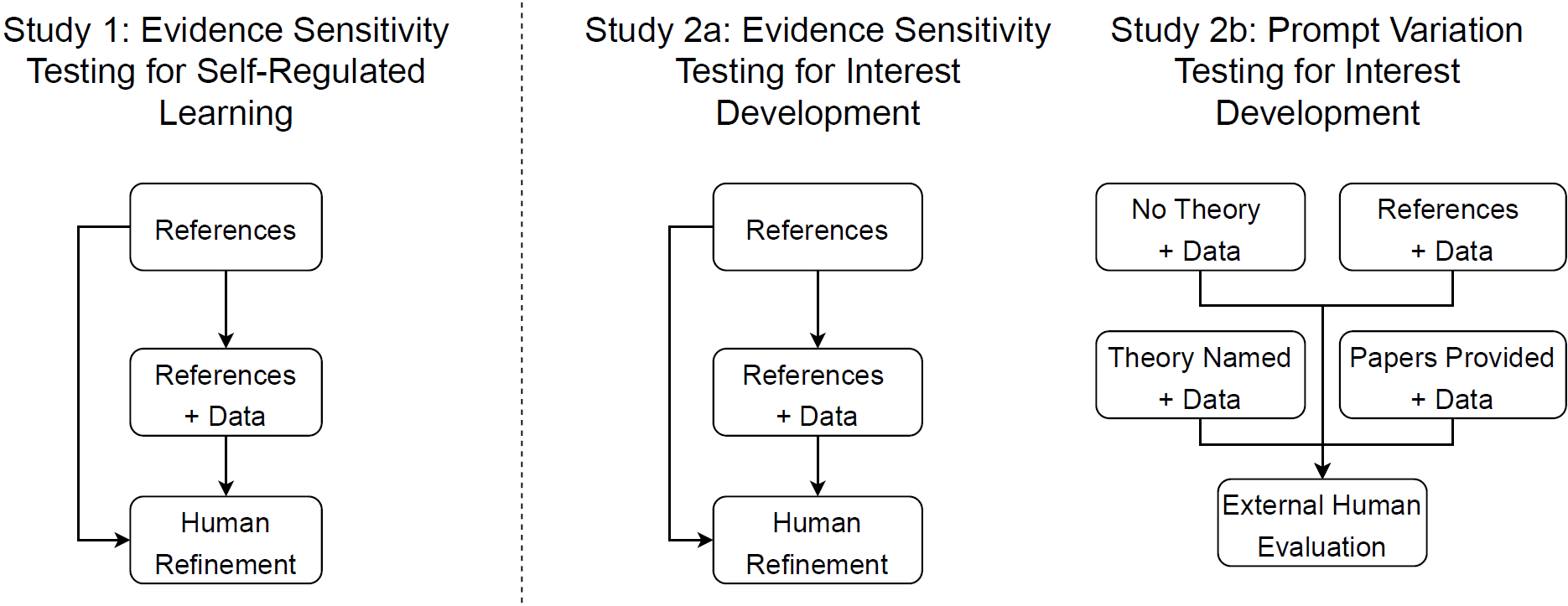
For the SRL context (Study 1), we implemented a three-step process to create a codebook grounded in two foundational SRL theories: Winne and Hadwin (1998) and Zimmerman (2000), both widely used in the learning sciences. First, we prompted GPT-4o to generate a baseline codebook drawing solely from its knowledge base about the two foundational SRL papers, explicitly including full references in the prompt. Second, we provided GPT with both the theoretical frameworks and our data (think-aloud transcripts from several learning contexts) to examine how it applied SRL theory to identify patterns in authentic student behavior. Finally, two human coders reviewed and refined the codebook generated in the second step (cf. Barany et al., 2024), allowing us to assess the outcomes of a collaborative human-AI coding process and the extent of human input needed to produce a usable, theory-aligned codebook.
We then attempted to replicate this process in a second context, focusing on Hidi and Renninger’s (2006) four-phase model of ID (Study 2). This framework was chosen because, unlike SRL theories, it operates at a more abstract level, reflecting the many ways interest can manifest and thus posing a potentially greater challenge for GPT. Using the same prompt structure as in the SRL case, we observed that GPT produced theoretically aligned but less practical results. This suggested an opportunity to explore additional prompt engineering strategies to effectively operationalize this theory. In response, we expanded our investigation in this context to explore alternative prompting strategies that might yield more relevant and usable codes. Therefore, Study 2 compares four prompt-engineering strategies to evaluate GPT’s capacity to generate useful and practical, theory-informed codebooks: (1) no explicit reference to theory, replicating the approach used in prior inductive studies; (2) naming the target framework without providing references; (3) supplying a list of references, as in Study 1; and (4) providing the full text of the foundational papers (see Figure 1). By systematically comparing these conditions, we aim to understand how different types of theoretical input influence the constructs generated by GPT and identify which strategies yield the most valid and actionable codebooks. Overall, this work seeks to evaluate GPT’s effectiveness as a collaborator in codebook development when guided by established learning theories and to identify the most effective ways to communicate these frameworks in practice.
LLMs in Qualitative Research
LLMs for Automated Coding
LLMs have been proposed as valuable tools for enhancing qualitative research. Most prior work has demonstrated promising performance on automating coding processes in educational research (e.g., Morgan, 2023; Liu et al., 2025) as well as in other domains (Chew et al., 2023; Kirsten et al., 2024). For instance, Liu et al. (2025) compared GPT-4’s performance across three different contexts. In the first, they coded transcripts of human-human tutoring using three prompting strategies: Zero-shot (no examples), Few-shot (with examples), and Few-shot with context (prompts with examples and context). The study found that Zero-shot prompting was most effective for codes with clear, unambiguous definitions, Few-shot prompting worked better for concrete constructs that still require illustrative examples to clarify their meaning, and Few-shot with context was only beneficial for constructs that explicitly require contextual information. In some cases, however, this added context overwhelmed GPT and reduced performance. These prompting strategies were also tested by the authors on student-written observations while playing an astronomy-focused educational game, and on programming assignments from an introductory computer science course. Across these additional contexts, both Zero-shot and Few-shot approaches showed strong performance for most constructs. Similarly, Morgan (2023) examined GPT’s ability to identify key themes in focus group transcripts from two contexts: first-year graduate students and dual-earner caregivers. They found that GPT performed reasonably well with concrete, descriptive themes but struggled to identify more subtle, interpretive themes. Together, these studies suggest that GPT is well-suited for coding qualitative data involving clearly defined, concrete constructs, but tends to show greater disagreement with human researchers when dealing with constructs that require more interpretive nuance.
Building on this line of inquiry, Borchers et al. (2025) evaluated a multi-agent system designed to code interactions between tutors and students in a virtual environment. Their system included a single-agent coder to simulate individual annotation, a dual-agent discussion module to model inter-annotator dialogue, and a consensus agent responsible for finalizing codes after reviewing both responses. The findings showed that consensus was more easily reached when discussions involved LLMs operating at low temperature with assertive personas, and that both single-agent and consensus outputs demonstrated high agreement with human coding. These findings strengthen the case for the viability and usefulness of incorporating LLMs into qualitative coding processes.
Other work in this area has also focused on analyzing how GPT can assist in analyzing and discussing coding disagreements between researchers (both human-AI and even human-human; Zambrano et al., 2023; López-Fierro et al., 2025). In particular, Zambrano et al. (2023) proposed leveraging the conversational abilities of LLMs (ChatGPT-3.5) not only to automate coding but also to explain its coding decisions and revise coding categories. This process can help researchers evaluate whether their own code definitions and labeling strategies need refinement. Although overall LLM coding performance metrics were not as good as in later work, the authors identified instances where human coders were inconsistent in their labeling, for which GPT was able to offer clarifications to construct definitions and explanations for why disagreements may have occurred. Likewise, López-Fierro et al. (2025) found that even when ChatGPT-4 disagrees with human coders, prompting GPT to explain not only its own rationale but also the potential sources of disagreement provided insights that can complement researchers’ labeling and encourage reflection on the clarity and precision of the construct definitions. Both studies suggest that GPT’s conversational capabilities may offer valuable support for broader aspects of qualitative research, including collaborative reflection, code validation and iteration, and deeper construct understanding.
LLMs for Codebook Development
Emerging studies have demonstrated the potential of human-AI collaboration across multiple qualitative tasks, including resolving ambiguity in human-developed codes (Jiang et al., 2025), revealing researcher positionality (Bialik et al., 2025), and identifying data subsets that may be especially informative for researchers (Schäfer et al., 2025). As LLMs become more integrated into collaborative coding processes, their role is shifting from functioning solely as automated coders to serving as reflective partners. Motivated by LLMs’ ability to use human-created codebooks to inform their decision-making, researchers have proposed frameworks for developing codebooks and conducting thematic analysis in collaboration with LLMs (De Paoli, 2024; Gao et al., 2024; Katz et al., 2024). For example, De Paoli (2024) introduced a workflow using OpenAI’s Application Programming Interface (API) and GPT-3.5 (the latest version at the time) in which human researchers prompt GPT to identify key themes and example sentences in a pre-cleaned dataset, reduce duplicate codes, and generate definitions of those codes. De Paoli demonstrated that GPT could identify key items in two education-related datasets with minimal human intervention, requiring experts only to clean the input and review the output. Gao et al. (2024), also using OpenAI’s API and GPT-3.5, extended this framework to not only leverage GPT for suggesting codes based on data but also to facilitate discussions among multiple human researchers and suggest grouping constructs for overlapping codes. Lastly, Katz et al. (2024) employed an open-source LLM to identify common topics, sentiments, and themes, and then used text embeddings (numerical representations of language) and clustering analysis to group similar utterances. The LLM was then used to generate themes for each cluster, suggesting preliminary codes that were reviewed and refined by human experts to ensure they accurately represented the data and aligned with the research objectives.
To understand which aspects of thematic analysis are best supported by LLMs, Chen et al. (2025) analyzed open coding outcomes produced by five LLM-based approaches and four human coders using a dataset of online chat messages about a mobile learning application. The LLM-based approaches differed in several ways: the type of LLM used (BERT vs. GPT-4o), the method of presenting and coding the data (in chunks vs. line-by-line), and the nature of the requested output (broad themes vs. more specific codes). In none of these approaches did the LLMs receive codebooks or example codes in advance. The authors found that LLMs, across all configurations, were effective at identifying concrete, content-grounded codes. In contrast, human coders excelled at generating codes that captured more interpretive and conversational dynamics (something LLMs struggled with). Similarly, Barany et al. (2024) examined four approaches to codebook development: a fully manual approach, a fully automated approach employing GPT-4, and two hybrid approaches incorporating GPT at specific steps of the codebook development process. In the first hybrid approach, GPT was used to refine a codebook initially developed by human researchers. In the second, GPT generated an initial set of constructs, which were then refined by a human researcher. The authors found that hybrid approaches, whether GPT is involved early or later in the process, produced codebooks that can be more reliably applied even by human coders and rated as higher quality by independent human reviewers.
These codebook development approaches have recently been applied across a range of educational contexts. For example, Wei et al. (2025) used a hybrid method in which GPT-4o generated initial constructs from a large dataset, which were then manually refined to create a codebook to compare in-game written observations from students with high and low situational interest in a Minecraft-based learning environment. The analysis revealed that students with higher situational interest made observations across a broader range of topics, particularly emphasizing scientific content. Similarly, Ruijten-Dodoiu (2025) asked ChatGPT to extract potential codes from student-AI interaction data and then manually validated and refined the themes. While the GPT-generated themes included some inaccuracies, such as a fabricated trend suggesting all students trusted AI, the iterative interaction with GPT ultimately produced useful insights. The refined themes identified key ways that students used AI in their writing: transforming informal text into formal academic language, meeting word count requirements, exploring weaknesses in their own writing, retrieving factual or referenced information, and structuring discussion points. The analysis also highlighted that some students appeared to rely excessively on GPT for completing writing tasks.
Multi-agent systems built on LLMs have also been investigated as tools to conduct thematic analysis. Simon et al. (2025) propose a workflow that automates the process previously carried out through more manual interactions with LLMs by Barany et al. (2024). In this workflow, an orchestrator agent breaks down the overall procedure of thematic analysis into smaller tasks and assigns those tasks to several coding and consensus agents. Each coding agent independently reviews the text data and generates potential themes or codes, much like individual human coders. A consensus agent then compares these outputs, merges similar codes, and resolves disagreements, mirroring the collaborative practices of human research teams. Using this approach, the authors found that a multi-agent system based on Claude 3.5 Sonnet achieved a high level of coding consistency with human experts when performing inductive thematic analysis on a benchmark dataset, particularly for concrete and descriptive themes.
Although hybrid codebooks have proven useful in educational research, most prior approaches (Barany et al., 2024; De Paoli, 2024; Gao et al., 2024; Katz et al., 2024; Chen et al., 2025) have used GPT in a primarily inductive fashion, without grounding the theme identification in any theoretical framework. To address this limitation, Ramanathan et al. (2025) iteratively refined prompts using chain-of-thought prompting, applying consistency checks until a theoretically grounded operationalization was achieved. In their approach, theory was manually embedded into the prompt by providing GPT with a human-developed, theory-based codebook. While this represents an important step forward, the optimal method for identifying theoretically grounded constructs remains unclear. For instance, allowing GPT to generate the codebook itself, drawing on both the data and the underlying theory rather than supplying a pre-existing codebook, may lead to more insightful and contextually relevant results.
Research in other areas outside of education also suggests that how the theoretical information is presented to GPT could be important. For example, studies have found that prompting GPT with excessive contextual information or overly detailed instructions can reduce its accuracy in performing the intended task (Koopman and Zuccon, 2023; Peters and Chin-Yee, 2025). Moreover, research suggests that there are specific qualities of scientific write-ups (e.g., the differences in tense, the use of hedges) that may influence the degree to which LLMs generalize to new information (Peters and Chin-Yee, 2025). Therefore, it is possible that LLMs’ ability to generate new codes based on a specific theoretical framework could be influenced by the researchers’ writing style. Finding ways to mitigate such concerns would be an important step in developing prompt-engineering frameworks (see review in Sahoo et al., 2024) that would improve LLMs’ ability to effectively assist in this type of research tasks. To that end, this study explores multiple ways of presenting theoretical frameworks to GPT in order to identify strategies that lead to more practical, relevant, and theoretically aligned codebooks.
Study 1: Developing a Codebook to Investigate Self-Regulated Learning
Theoretical Framework
The first theoretical framework for which we developed codebooks in collaboration with GPT was SRL. Grounded in both information-processing and social-cognitive traditions, various theoretical frameworks have defined SRL as a cyclical and loosely sequenced process that involves a dynamic interplay among cognitive, metacognitive, motivational, and emotional components within and across learning episodes, while also being shaped by learner characteristics, task demands, and the social context (Panadero, 2017; Greene et al., 2023). Among these frameworks, Zimmerman’s (2000) cyclical phases model and Winne and Hadwin’s (1998) four-stage model have been especially influential in guiding the development of qualitative codebooks for analyzing SRL behaviors (e.g., Bannert et al., 2014; Hutt et al., 2021; Borchers et al., 2024), making them an important reference point for testing GPT’s capacity to generate theory-based codebooks.
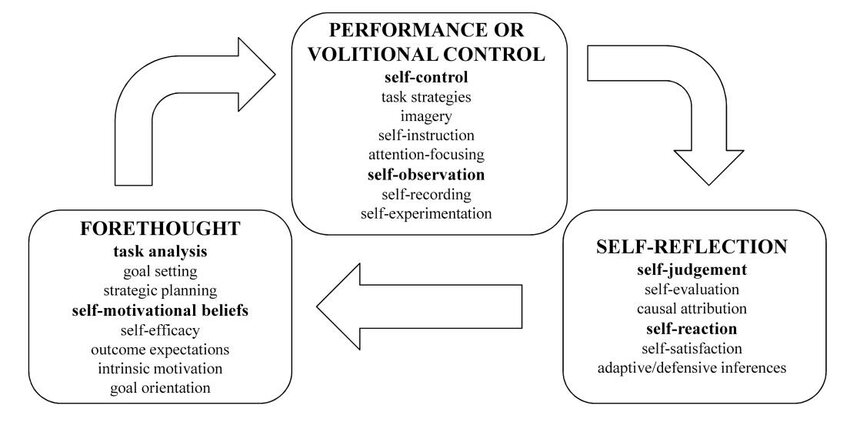
Based on socio-cognitive theories, Zimmerman (2000) describes SRL as three cyclical phases (i.e., forethought, performance, and self-reflection), in which learners analyze a task, execute it, and assess their performance. In the forethought phase, learners set goals and develop strategies, with task analysis and self-motivation as key components. Motivational beliefs such as intrinsic interest or self-efficacy (personal beliefs about one’s abilities) can influence goal-setting behaviors, ultimately impacting the level of difficulty of the goals a learner sets and their commitment to achieving them. In the performance phase, learners engage in two main processes (self-control and self-observation) to ensure the successful execution of their plan. Self-control involves strategies that help learners stay focused on the task and optimize their effort, while self-observation encompasses methods for monitoring their performance and the surrounding conditions. Finally, in the self-reflection phase, learners evaluate their performance against a set of criteria (self-evaluation) to determine whether success or failure is due to internal or external factors. Their level of satisfaction with the outcome (self-satisfaction) and their preferred response style (adaptive-defensive) subsequently influences their future regulatory behaviors (see Figure 2).
Grounded in information processing theory, Winne and Hadwin (1998) characterize SRL as a process involving four interdependent and recursive stages, in which learners: 1) define the task, 2) set goals and form plans, 3) enact the plans, and 4) reflect on and adapt strategies if goals are not met (Figure 3). Winne and Hadwin (1998) specifically highlight the importance of cognition and metacognition in this process. To describe how learners navigate tasks at each stage, they proposed the COPES model, which outlines five core components involved in self-regulation. According to this model, learners assess task conditions (C), engage in cognitive operations (O) to generate a product (P), and evaluate (E) that product against internal or external standards (S).
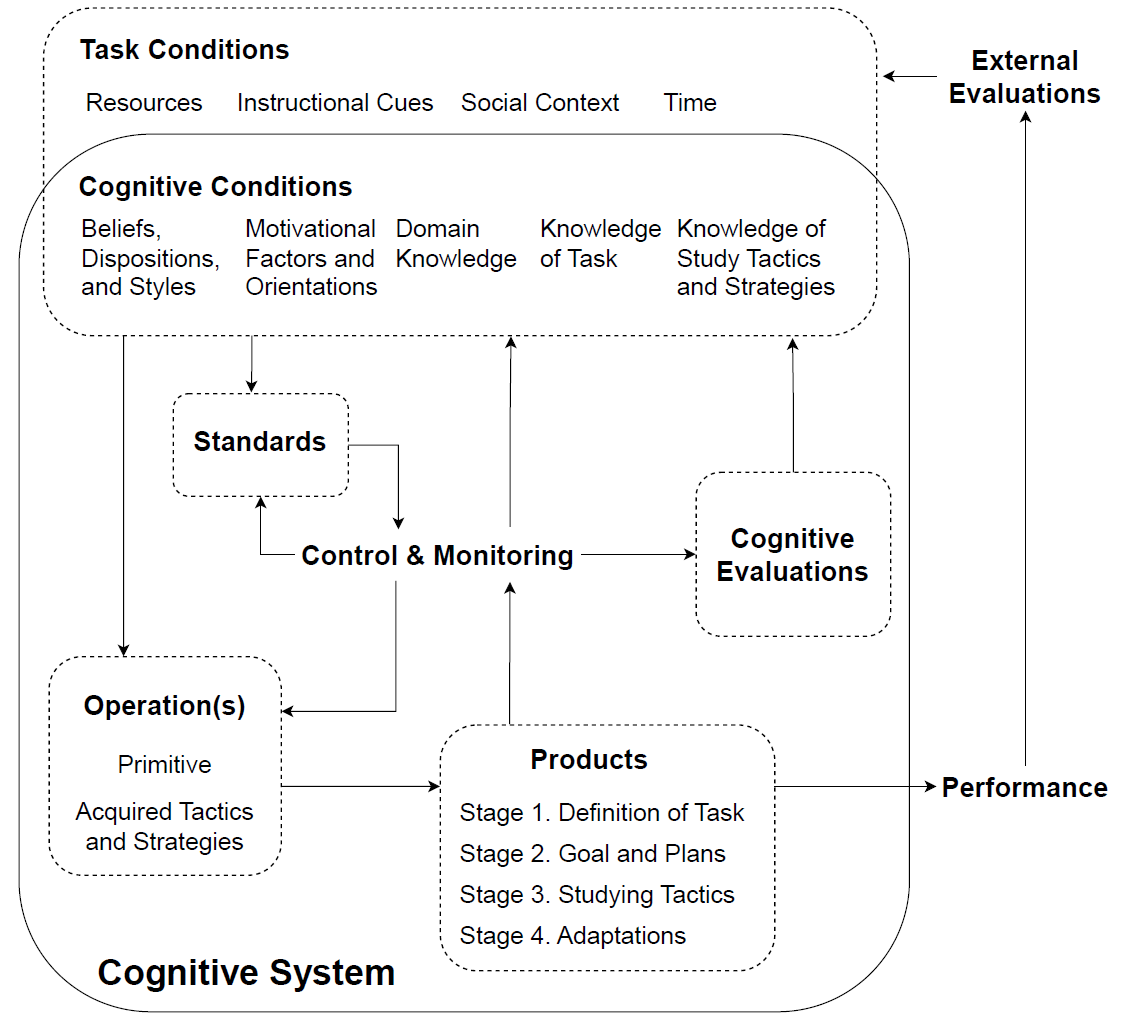
Zimmerman’s and Winne and Hadwin’s SRL models share several foundational assumptions about how learners manage their own learning processes. Both frameworks represent SRL as a cyclical and dynamic process in which learners set goals, select and implement strategies, monitor their progress, and adjust behaviors based on feedback. They also emphasize the central role of metacognition (particularly monitoring, self-control, and adaptation) and acknowledge that motivation and contextual factors shape how learners engage with and sustain learning tasks. Despite these shared principles, the models differ in their theoretical grounding and in the emphasis they place on specific SRL components. Zimmerman’s model, rooted in social cognitive theory, organizes SRL into three broad phases (forethought, performance, and self-reflection) and highlights motivational constructs such as self-efficacy, goal orientation, and self-satisfaction. It represents a relatively higher-level account of the processes of SRL, less fine-grained than Winne and Hadwin’s model. In contrast, Winne and Hadwin’s model adopts an information-processing perspective, presenting SRL as a more fine-grained and mechanistic process in which learners regulate their behavior through the interaction of Conditions, Operations, Products, Evaluations, and Standards, offering a more detailed account of how learners interpret, monitor, and respond to task demands in real time.
As a multidimensional construct, SRL encompasses various aspects that GPT can help examine and synthesize. The two selected frameworks capture a wide range of SRL processes, including behavioral, affective, cognitive, and metacognitive components, making them good tests of GPT’s ability to develop a comprehensive codebook. Moreover, both models are now well established in the literature, suggesting that sufficient information on these frameworks is likely included in the training data of GPT. Preliminary checks asking GPT about the theory confirmed that GPT can accurately summarize all the key elements of the model, suggesting it is appropriate for evaluating GPT’s ability to generate theoretically grounded codebooks.
Data Context
To assess GPT’s capacity for suggesting constructs related to SRL, we selected an open dataset that has previously been coded (by humans) and analyzed for SRL using a custom codebook based on the theory by Winne and Hadwin (Borchers et al., 2024; Zhang et al., 2024a). The dataset consists of think-aloud transcripts from students working within three intelligent tutoring systems (ITSs). These systems covered topics in stoichiometry (Stoichiometry Tutor, McLaren et al., 2006; and ORCCA, King et al., 2022) and formal logic (Logic Tutor, Zhang et al., 2024b). Fourteen undergraduate students and one graduate student participated in the study between February and November 2023 in the United States. The participants’ demographics were 40% white, 47% Asian, and 13% multi- or biracial. Ten students were recruited from a private research university and participated in person, while five students from a large public liberal arts university participated remotely via Zoom.
Students participated in a 45-60 minute session, where they were assigned to one of three ITSs. Each system had at least five students, with six students working on both stoichiometry ITSs after completing one early. The session began with a demographic questionnaire, followed by a pre-recorded introductory video on the assigned ITS, with an opportunity to ask questions afterward. For Logic Tutor, students were also given the option to skim and ask questions about articles on formal logic. After becoming familiar with the tutoring software, students received a brief demonstration and an introduction to the think-aloud method. They then began working on the tutor problems at their own pace for up to 20 minutes while thinking aloud, with occasional reminders from the experiment conductor to keep speaking. The problems were matched in difficulty across the ITSs. The stoichiometry tutors covered mole and gram conversion and stoichiometric conversion (four problems each), while the Logic Tutor focused on simplifying and transforming logical expressions (seven and four problems, respectively). The data set includes a total of 955 utterances transcribed using Whisper, which were segmented based on logged interface interactions in the tutoring systems (see Zhang et al., 2024b). Log data and anonymized synchronized think-aloud transcripts are available upon request for Stoichiometry Tutor and ORCCA at https://pslcdatashop.web.cmu.edu/DatasetInfo?datasetId=5371 and for the Logic Tutor at https://pslcdatashop.web.cmu.edu/DatasetInfo?datasetId=5820.
GPT-based Codebook Development
To create the SRL codebook, we employed a three-step process. In the first step, we used GPT to generate a codebook based solely on GPT’s knowledge of foundational theory papers (i.e., Winne and Hadwin, 1998; Zimmerman, 2000) which inspired qualitative coding in past papers involving this data set (Borchers et al., 2024; Zhang et al., 2024a; 2024b). In the second step, in addition to the theory papers, we provided GPT with data intended to be analyzed within the SRL framework. In the final step, two human coders reviewed and refined the codebook generated in the second one, merging overlapping constructs and excluding constructs that the coders found challenging to identify from the data (cf. Weston et al., 2001; Barany et al., 2024).
When prompting GPT, we used GPT-4o (version gpt-4o-2024-08-06) via OpenAI’s GPT API. Given the stochastic nature of GPT, which may generate different results for equivalent prompts, the temperature parameter was set to 0—a standard practice in this type of research, (e.g., Barany et al., 2024; Liu et al., 2025)—and each prompt was run three times to verify consistency across iterations (as in Wang et al., 2022). We conducted several rounds of prompt modifications to guide the model in generating consistent and reliable outputs, following the prompt engineering framework proposed by Giray (2023). This process began with a broad prompt asking GPT to develop a codebook for SRL. Then, multiple variations were tested, and iterative adjustments were made to add specificity and contextual details relevant to this codebook development. The prompts presented here are the final versions obtained after the prompt engineering process.
Step 1: Prompting GPT with Theory Paper References
In the first step (Theory-only), we asked GPT to consider two foundational SRL theory papers (Winne and Hadwin, 1998; Zimmerman, 2000). The prompt shown below was given to GPT as both the system and user message. In the API, the system message defines the assistant’s behavior, tone, and guiding context and the user message provides the specific question or instruction to which the assistant responds.
System/User Message:
You are an expert qualitative researcher in self-regulated learning. Please create a codebook for analyzing students’ think-aloud transcripts considering the following papers:
- Winne, P.H. and Hadwin, A.F. 1998. Studying as Self-Regulated Learning. Metacognition in Educational Theory and Practice. (1998), 277–304.
- Zimmerman, B.J. 2000. Attaining Self-Regulation: A Social Cognitive Perspective. Handbook of Self-Regulation. 13–39.
Each round of the prompt generates a codebook containing constructs along with their definitions and (synthetic) examples. Two researchers (the 1st and 2nd author) consolidated the codebook by considering all constructs that appeared in any of the three runs. Specifically, constructs with similar names and definitions across multiple rounds were treated as the same (e.g., Self-Monitoring and Self-Observation). Constructs that appeared similar but were not clearly identical for both human researchers (e.g., Planning versus Goal Setting and Monitoring versus Evaluation) were not merged and were included in the codebook as individual and separate constructs.
Step 2: Prompting GPT using both Theory Papers and Data:
In the second step (Theory+Data), we incorporated student data into GPT’s prompting. We retained the same system message used in the Theory-only approach but modified the user message (shown below) to include the dataset. The entire dataset was provided within a single prompt, with each utterance separated by a line break. This formatting allowed GPT to select specific utterances as examples for constructing the codebook.
User Message:
As a qualitative researcher, you can refine constructs proposed in previous theories and suggest new constructs by considering the transcripts that you analyze. Please refine this codebook considering the following transcripts: [FULL DATASET]
In line with Step 1, authors 1 and 2 evaluated construct overlap across all three runs, consolidating all the generated constructs into a single codebook. Constructs that were similar but not clearly identical were again not merged.
Step 3: Final Human Refinement
In the third step (Human Refinement), the 1st and 2nd authors evaluated the specificity (the extent to which a construct is distinct and clearly distinguishable from other related concepts) and applicability (the extent to which a construct can be accurately identified in the data) of the definitions and examples for all constructs obtained in the previous steps. Constructs that did not match the context of the data or included example sentences that did not align with the construct’s definition were filtered out. For example, Imitation was defined by GPT in Step 1 as “observing and imitating the strategies or behaviors of others,” but no such instances were found in the data (as indicated by its absence in Step 2), and it was therefore excluded. No hallucinations (i.e., example sentences created by GPT and not present in the data) were found in this study, but if suitable examples could not be identified in the data, the construct was excluded. Constructs that had similar definitions or overlapping examples but were not clearly identical (e.g., Planning versus Goal Setting and Monitoring versus Evaluation) were collapsed if both researchers agreed they should be combined; all others remained as generated by GPT. Additionally, constructs that were a subset of another construct also proposed by GPT were collapsed into the broader construct if this broader construct was concrete enough and easy to observe in the data. For instance, the construct Task Understanding, defined as correct task comprehension, was collapsed into a broader but comparable construct also in the codebook, Understanding the Task, defined as the process of trying to understand the task. These approaches aligned with existing practices for code refinement in qualitative research (e.g., Strauss, 1987). Given that the primary goal of the study was to evaluate the outcomes of using GPT for codebook development, rather than to assess the researchers’ ability to propose theoretically grounded constructs, no additional constructs beyond those suggested by GPT were added by the researchers.
Results
Step 1: Prompting GPT with Theory Paper References without Providing Data
As Table 1 shows, the codebook suggested by GPT based on the SRL foundational theory papers accurately represents most of the key elements of both SRL theories, indicating that the model’s knowledge base includes appropriate and accurate representations of these theoretical frameworks. GPT proposed constructs that capture all the components across all three phases of Zimmerman’s cyclical self-regulatory model. For Zimmerman’s forethought phase, both the task analysis and self-motivation components were represented by the constructs Goal Setting, Strategic Planning, Self-Efficacy, Intrinsic Motivation, and Task Value. Similarly, Zimmerman’s performance phase, which includes self-control and self-observation, was reflected by the constructs Strategy Use, Resource Management, Adaptive Inferences, Task Monitoring, Self-Monitoring, and Metacognitive Awareness. Finally, the self-reflection phase (self-judgment and self-reaction) was represented by the constructs Reflective Thinking, Adaptive Inferences, Self-Evaluation, and Outcome Evaluation.
|
Step 1: Theory References |
Step 2: Theory + Data |
Step 3: Human Refinement |
|---|---|---|
|
Understanding the Task Task Understanding |
Understanding the Task |
|
|
Goal Setting Strategic Planning |
Goal Setting Strategic Planning |
Planning & Goal Setting |
|
Self-Evaluation Outcome Evaluation |
Error Identification Outcome Evaluation Process Evaluation |
Error Identification |
|
Self-Monitoring Task Monitoring Metacognitive Awareness Reflective Thinking |
Monitoring |
Monitoring |
|
Strategy Use |
Systematic Strategy |
Strategy Use |
|
Adaptive Inferences |
Strategy Adjustment |
Strategy Adjustment |
|
Seeking Help |
Seeking Help |
Help-seeking |
|
Resource Management |
||
|
Self-Efficacy |
Emotional Regulation Self-Efficacy |
Emotional Regulation & Perseverance |
|
Frustration |
Frustration and Self-Doubt |
|
|
Calculation & Conceptual Understanding |
Domain Knowledge Recall |
|
|
Trial and Error |
Trial and Error |
|
|
Intrinsic Motivation |
||
|
Physical Environment |
||
|
Social Environment |
||
|
Imitation |
||
|
Task Value |
Similarly, GPT’s codebook contained constructs for three of the four phases of Winne & Hadwin’s SRL model: set goals and form plans, enact the plans, and reflect and adapt strategies when goals are not met) Only the task definition phase, which occurs before goal setting and planning, is not directly represented in the codebook. That said, Goal Setting and Strategic Planning necessitate a task definition, and it is possible that differentiating between the two would be hard to operationalize.
Although Step 1 suggestions provided good coverage of the different phases of the SRL theories, many of the codes suggested by GPT show substantial overlap with one another, even when they ostensibly cover different phases of SRL. For instance, constructs such as Self-Monitoring, Task Monitoring, Reflective Thinking, and Metacognitive Awareness are conceptually distinct, but may manifest in similar ways. For example, the similarity between the examples like “I think I understand this part, but I’m not sure about the next section” (GPT’s example for Self-Monitoring) and “Next time, I should try a different strategy for better results” (GPT’s example for Reflective Thinking) made it difficult to consistently differentiate between these codes. As will be discussed in the section on Step 3 (below), such codes were collapsed prior to further analysis.
Another concern about the Step 1 codebook was related to the applicability of several codes to this particular data set. For example, constructs like Imitation and Social Environment are important components of SRL models, but their applicability is highly limited in the current data set, where students worked individually within the learning platform and while producing data through a think-aloud protocol. In this context, students were not given opportunities to produce data connected to these constructs. As a result, synthetic examples suggested by GPT for these constructs (e.g., “I noticed my classmate uses flashcards, so I will try that too”) were not plausible. Hypothetically, students could have referred to past experiences involving others (e.g., strategies they copied from a teacher or classmate). However, our data showed no such references, indicating that neither construct is appropriate for coding this specific data set and context.
Step 2: Prompting GPT using both Theory Paper References and Data
We next tested GPT’s sensitivity to the SRL study’s data to determine how that might influence the codebook generation process. When provided with the data, GPT produced a codebook that was more complete (see Table 1), capturing elements from all phases of both theoretical models. This is an improvement over the Step 1 (Theory-only), as the Step 2 (Theory+Data) codebook incorporated Winne & Hadwin’s phase of task definition, the only phase of their SRL model missing from the Step 1 approach. In Step 2, GPT differentiated between the process of attempting to grasp the task (Understanding the Task), attaining accurate task comprehension (Task Understanding), and the forethought phases focused on Goal Setting and Strategic Planning. All other stages from both Zimmerman’s and Winne and Hadwin’s SRL models were represented in the Theory+Data codebook.
GPT also produced fewer overlapping constructs than it did in Step 1. For example, the Theory+Data codebook included a code called Monitoring, which was illustrated using the same examples from the four overlapping constructs in the Theory-only codebook (Self-Monitoring, Task Monitoring, Reflective Thinking, and Metacognitive Awareness). This suggests that the Step 2 codebook may have more effectively identified and labelled these examples as a single construct.
GPT also introduced a new construct, Error Identification, which was not present in Step 1. This construct captures instances where students explicitly recognize a previous mistake or incorrect answer (e.g., “And now I just realized that I should have done all the equations first.”). Although this construct does seem to be a type of Monitoring, the specificity of Error Identification made it easier to differentiate from other types of monitoring behaviors.
Furthermore, GPT provided codes in Step 2 that better differentiated between different types of behaviors in the performance (Zimmerman) or enactment (Winne & Hadwin) phases of the SRL models. GPT suggested codes like Trial-and-Error (e.g., “I’m going to submit this guess now”), differentiating from Systematic Strategy (e.g., “Let’s make some notes that we don’t forget anything like the 6 before.”). GPT also identified instances where students used Calculations & Conceptual Understanding while solving tasks (e.g., “Let’s use inverse absorption to simplify this expression”). This additional code could help identify cases where conceptual knowledge guides students’ strategies and processes.
Finally, constructs that were relevant to the theory but absent from the data (see discussion in Section 3.4.1), were appropriately filtered out by GPT once the data was available. For example, Imitation and Social Environment, which emerged in Step 1, did not appear in Step Two. Several motivational constructs were also either excluded or replaced with more specific constructs such as Frustration (e.g., “This is driving me crazy with all the denominators”) and Emotional Regulation & Perseverance (e.g., “This is frustrating, but I’ll keep trying.”). As a result, the Step 2 codebook showed better alignment with the students’ think-aloud data.
Step 3: Final Human Refinement
The Step 2 (Theory+Data) codebook improved upon the Step 1 codebook by reducing the number of overlapping constructs, enhancing the specificity of proposed constructs, and providing constructs that were more relevant (sensitive) to the think-aloud data. However, further human refinement was still warranted. This refinement process resulted in a final codebook consisting of eleven constructs. Definitions and examples for each construct are presented in Table 2.
In some cases, codes were simply renamed and refined. For example, GPT defined Calculation & Conceptual Understanding as the “explicit use of domain-specific knowledge or mental calculation to understand and solve the task,” and provided the example, “Let’s use inverse absorption to simplify this expression.” Given concerns about GPT’s ability to distinguish between correct and incorrect uses of technical terms (e.g., “absorption,” “Avogadro’s number,” or “De Morgan’s law”), human researchers refined and renamed this construct Domain Knowledge Recall.
In many cases, codes generated by GPT were merged into a single category when the examples were too close to provide a meaningful distinction. For instance, GPT distinguished between students working towards understanding (Understanding the Task) and achieving understanding (Task Understanding). Example sentences for the former included “Let’s figure out how many hydrogen atoms are in a millimole of water, H2O molecules” while examples for the latter included “Let’s figure out how many CO2s there are in a single millimole of C2H6.” Although human experts with access to the data could discern whether students understood the task correctly, this approach may not be practical for large datasets where full human inspection is infeasible. Therefore, the researchers merged them into a single category: Understanding the Task.
Code & Definition | Example Utterances from the Data |
|---|---|
Understanding the Task: Specific mental processes used to understand the task. | "Let’s figure out how many hydrogen atoms are in the millimole of water" |
Planning & Goal Setting: Students outline their goals, objectives, or strategy before engaging in the planned action. | "I’m going to first handle the negation and then move to the next part." |
Error Identification: Students detect an error in the process or solution of the task | "So I guess the 25m I wrote there is not correct." OR "Oh, I missed a negation, let me fix that." |
Monitoring: Checking understanding or progress during the task. | "Am I reading the statement again and see if I forgot anything?" |
Strategy Use and Execution: Applying systematic steps to solve the problem. | "I’m going to multiply this by Avogadro’s number." |
Strategy Adjustment: Actions taken to correct or adjust strategies based on monitoring. | "Let's make some notes that we don't forget anything like the 6 before." OR "So I'm going to do it the safe way." |
Help-seeking: Use of hints or external resources when the student is unsure or stuck. | "OK, I’m asking for a hint now." OR "Let’s get the second hint." |
Emotional Regulation & Perseverance: Perseverance and determination despite difficulty, ambiguity, or frustration | "This is frustrating, but I’ll keep trying." OR "I’m almost there, just one more step!" |
Frustration & Self-doubt: Frustration with repeated errors or setbacks. | "This is driving me crazy for all the denominators." |
Domain Knowledge Recall: Statements referring to subject-specific concepts, equations, or principles. | “Let’s use inverse absorption to simplify this expression.” |
Trial & Error: Experimenting with various rules or strategies when uncertain. | “I'm going to submit this guess now.” |
Similarly, GPT proposed Process Evaluation and Outcome Evaluation as distinct additional constructs to capture students’ reflections on their strategies and outcomes. However, the example sentences provided for these constructs were repeated for Error Identification (e.g., “And now I just realized that I should have done all the equations first” and “The result is no 100,000”), suggesting that all three may be capturing a similar underlying behavior. Consequently, during human refinement, the constructs were consolidated under the broader and more clearly defined construct Error Identification. Several other codes were also merged for the same reason. For instance, the examples given for Strategic Planning (e.g., “So I should determine the amount of C6H1206 in mole”) were not distinguishable from those given for Goal Setting (e.g., “Let's create the formula and just sum up what we've learned so far”). Even though construct definitions appeared distinct, human inspection found many data examples that could fit both codes, (e.g., “We need to apply absorption and simplify this part first.”). Since both codes were also theoretically similar (i.e., both belong to either Zimmerman’s forethought phase or Winne & Hadwin’s planning stage), they were merged into Planning & Goal Setting. Monitoring and Evaluation, Error Identification and Outcome Evaluation, and Self-Efficacy and Emotional Regulation also showed substantial overlaps in their definitions, examples, and theoretical mappings, and were therefore merged into Monitoring & Evaluation, Error Identification, and Emotional Regulation & Perseverance, respectively. In sum, while the use of GPT in Step 1 and Step 2 shows the potential of the tool for supporting theory and data-relevant codebook development, human review remains essential for code merging and codebook refinement.
Study 2: Developing a Codebook to Investigate Interest Development
Theoretical Framework
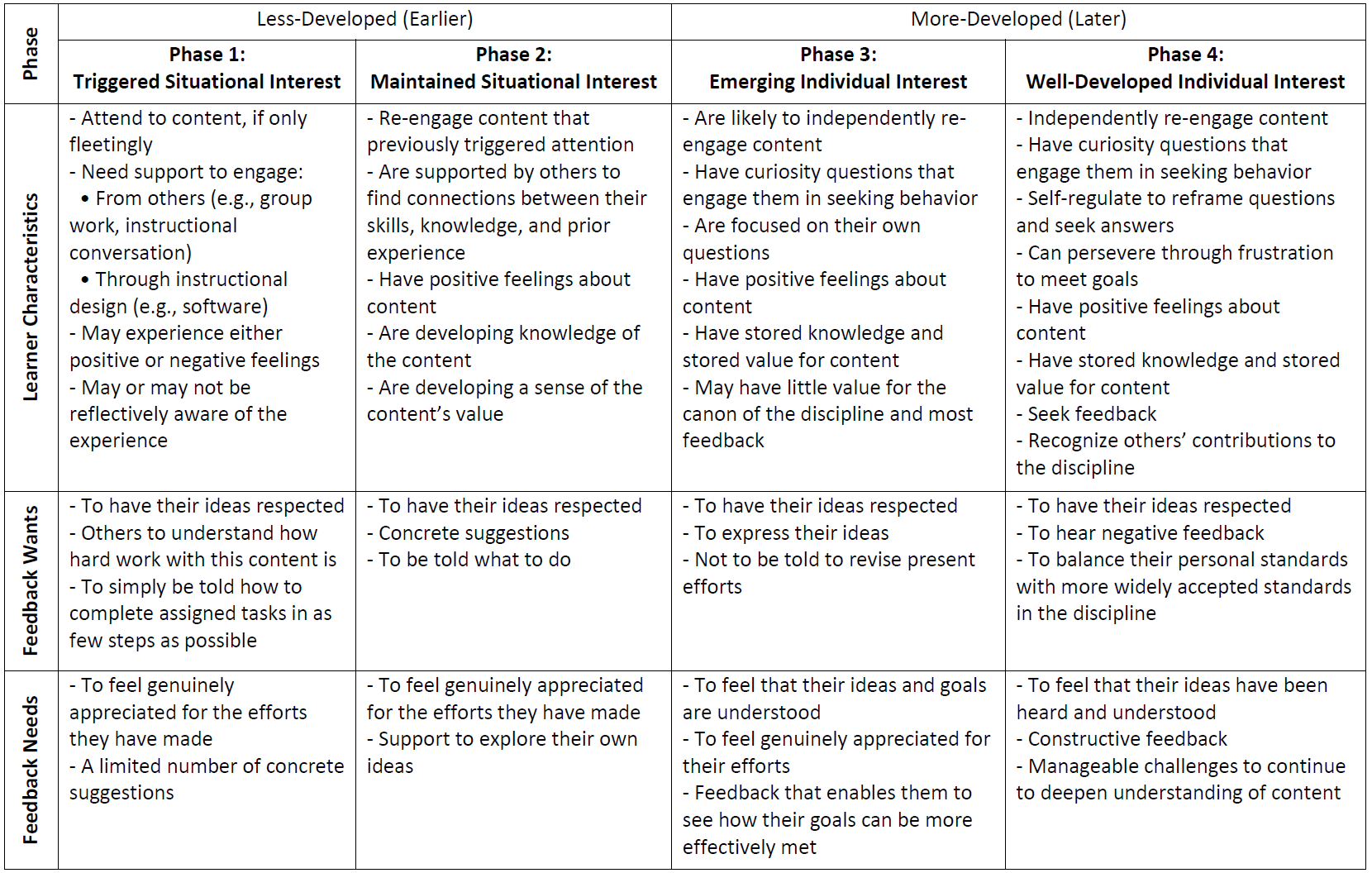
The second theoretical framework that informed GPT-assisted codebook development was student interest development. In particular, we focused on Hidi & Renninger’s Four-Phase Model of Interest Development (ID; Hidi and Renninger, 2006). This model outlines a progression of increasingly personal and sustained interest states: (1) triggered situational interest, a brief initial spark often stimulated by the learning environment; (2) maintained situational interest, involving prolonged engagement still influenced by external factors; (3) emerging individual interest, where learners begin forming personal connections and actively seeking out the topic; and (4) well-developed individual interest, characterized by long-term, self-sustained engagement, even in the face of challenges (see Figure 4).
In this framework, interest is not a fixed learner trait, but a dynamic, developmental process shaped by both environmental supports and individual motivation. In the early stages, external factors, such as engaging activities, novelty, and social interactions, play a critical role in sparking and sustaining interest. As students acquire more knowledge in a given domain, interest is internalized, and learners demonstrate greater autonomy, persistence, and depth of engagement (Hidi and Renninger, 2006). The model further highlights how cognitive, emotional, and behavioral indicators can signal different phases of interest development, ranging from momentary curiosity to sustained, meaningful engagement with a domain—often characterized by increased personal relevance, reflective thinking, and self-directed exploration.
Hidi & Renninger’s model provides an important test case as it is now well established in the literature. It has also inspired the development of several instruments related to interest development, including Linnenbrink-Garcia’s widely-used survey of situational interest (Linnenbrink-Garcia et al., 2010). Given its extensive recognition in the literature, we expect that sufficient data on this framework exists within the LLM training set. As with SRL models, preliminary checks confirmed that GPT can accurately summarize the key elements of the framework.
The four-phase model has seen widespread use in empirical research, in part because its high-level approach can be adapted to many settings. Although some scholars have noted that its conceptualization of interest development may appear broad or linear in certain contexts (e.g., Azevedo, 2011), this generality also allows for broad applicability. As a result, a codebook based on this theory must go beyond simply categorizing the four main stages of interest development. To generate deeper theoretical insights, the codebook must provide more detailed operationalizations that are suited to specific contexts (e.g., Linnenbrink-Garcia et al., 2010). This adds complexity to GPT’s task, requiring it to generate constructs, definitions, and examples that are not only theoretically grounded but also relevant to analysis in specific contexts. Consequently, this framework serves as a useful test case for assessing GPT’s ability to move beyond broad theoretical categories and produce nuanced, applicable codebooks.
Data Context
To evaluate GPT’s ability to suggest theoretically-driven constructs related to interest development, we analyzed 144 interview transcripts from 14 middle-school students who participated in a 5-day (15 hour) summer camp held in the northeastern United States in 2024 as part of the WHIMC project (Lane et al., 2022). The WHIMC project leverages Minecraft’s Java Edition to immerse learners in simulation environments where they can explore hypothetical astronomy scenarios that address “What-if” questions, such as “What if Earth had no moon?” or “What if Earth was orbiting a colder sun?”. Students differed in terms of gender (ten male, three female, and one non-binary) and race/ethnicity (eight White Americans, two Asian Americans, one European, and three individuals who preferred not to disclose). Participation in the research was entirely voluntary, with consent and assent obtained from parents and participants, respectively. Interviews were collected using an open-source app called Quick Red Fox (Hutt et al., 2022), which enables researchers to conduct Data-Driven Classroom Interviews (DDCIs; Baker et al., 2024) in the moment, as triggered by specific student actions that have been identified as potential indicators of interest, disinterest, or struggle. DDCIs allow interviewers to capture key moments in students’ interest development, resulting in a rich and timely dataset of student reflections that we then use to evaluate GPT’s codebook development capabilities. This data was provided to our team by members of the WHIMC research team.
Replication of Prompts Proposed for Study 1
We replicated the methods from Study 1, only modifying the prompt by changing the theoretical framework (ID instead of SRL) and the corresponding reference. We applied the same three-step process, generating codebooks using only the theoretical papers (Step 1), then with both the theoretical papers and the data (Step 2), and then through human refinement (Step 3).
In Step 1 (Theory Only), GPT generated a codebook that produced codes that mirrored the four phases of the ID model as the primary constructs for the codebook (Triggered Situational Interest, Maintained Situational Interest, Emerging Individual Interest, and Well-Developed Individual Interest; see Table 3). These four codes were proposed consistently across all three iterations. In addition, GPT also consistently identified the construct External Influences, defined as “factors outside the individual that influence interest development, such as teachers, peers, resources, and environment,” which represents broader contextual elements that can shape any of the four stages. Finally, GPT suggested constructs like Internal Motivations, Emotional Responses, and Barriers to Interest Development, though each appeared only once across the different runs.
|
Step 1: Theory References |
Step 2: Theory Papers + Data |
Step 3: Human Refinement |
|---|---|---|
|
Triggered Situational Interest |
Triggered Situational Interest Engagement |
Theoretical Phases |
|
Maintained Situational Interest |
Maintained Situational Interest Engagement |
|
|
Emerging Individual Interest |
Emerging Individual Interest Engagement |
|
|
Well-Developed Individual Interest |
Well-Developed Individual Interest Engagement |
|
|
Internal Motivations |
||
|
External Influences |
Peer Interaction |
Peer Interaction |
|
Situational Interest Support |
||
|
Instructor Interaction |
||
|
Social Challenges |
||
|
Emotional Responses |
Situational Interest Emotion |
Positive Emotion |
|
Individual Interest Emotion |
||
|
Emotional Challenges |
Negative Emotion |
|
|
Barriers to Interest Development |
Technical Challenges |
Technical Issues |
|
Task Challenge |
Cognitive Challenges |
|
|
Resources |
||
|
Situational Interest Stimulus |
Minecraft Environment Stimulus |
|
|
Environmental Factors |
||
|
Task Novelty |
||
|
Knowledge |
Knowledge |
|
|
Reflection |
Reflection |
|
|
Task Relevance |
Perceived Value |
|
|
Strategy Use |
Problem Solving |
|
|
Learning |
Learning |
Although these constructs align with the theoretical model, human reviewers found them to be too broad to effectively discriminate among different phenomena in the data. For example, GPT defined Maintained Situational Interest in a way that mirrors the theoretical literature (i.e., as characterized by “continued engagement with the subject matter over time, positive feedback or reinforcement from peers, teachers, or activities, and expressions of enjoyment or satisfaction from ongoing activities”). However, a code that reflects a broad, complex phase, characterized by considerable duration, is inappropriate for labeling an individual utterance in a student interview. A more useful operationalization of this construct would likely require breaking it down into more granular subcodes (e.g., Positive Reinforcement, Enjoyment or Satisfaction). Similarly, constructs such as Emotional Responses or Barriers to Interest Development, which emerged only once as a code across the runs on different data subsets, would benefit from further refinement to distinguish between positive and negative emotions or to identify specific challenges that may hinder students’ interest development.
In Step 2 (Theory+Data), GPT produced a codebook that was more expansive, including more narrow codes that still aligned with the theoretical model. For example, components from the earlier definition of Maintained Situational Interest, such as peer and instructor interactions and expressions of enjoyment or satisfaction, were further differentiated into distinct constructs: Peer Interaction, Instructor Interaction, Interest Emotions, Task Novelty, and Task Relevance. Similarly, the broader construct of Emotional Responses was refined into more specific categories, such as Situational Interest Emotions, Individual Interest Emotions, and Emotional Challenges. Barriers to Interest Development were also subdivided into more specific constructs, including Emotional, Social, Technical, and Task-related Challenges. Notably, the construct Internal Motivations was not suggested by GPT in this second step, as it did not identify an explicit example of it in the data.
Although many of the constructs generated in Step 2 were more practical than those in the original theory-only codebook, some still closely mirrored the theoretical interest development model without fully accounting for the practical challenges of identifying them in the dataset. For instance, Situational Interest Emotion and Individual Interest Emotion both refer to positive emotions or enjoyment associated with different phases of interest. While these distinctions are theoretically meaningful, they lack discriminant validity, since the positive emotions experienced during each are unlikely to differ at the level of a student utterance. The same concern emerged for Situational Interest Engagement and Individual Interest Engagement which are similarly difficult (if not impossible) to reliably distinguish in the context of interview transcripts.
The Step 2 codebook showed other forms of conceptual redundancy, with considerable overlap between constructs like Situational Interest Stimulus, Task Novelty, and Environmental Factors, all of which refer to aspects of the Minecraft environment that could trigger situational interest. Human reviewers determined these constructs were not sufficiently distinct and merged them to form the construct Minecraft Environment Stimulus in Step Three.
Other constructs from the Step 2 codebook offered finer-grained distinctions than the Step 1 codebook, but some still had validity issues. For example, the Social Interactions code proposed in Step 1 aligned with Step 2 codes that appeared more specific (i.e., Peer Interaction, Instructor Interaction, and Social Challenges) but GPT assigned examples to these Step 2 codes that were misleading. For instance, the construct Social Challenges, which appeared in only one run, included a question asked by the interviewer (i.e., “Your brother doesn’t like the sinking gravel?”) that did not refer to any conflict. In fact, the student responded that their brother was helping “a lot,” and corresponded to a moment of collaboration rather than challenge. Similarly, examples for Instructor Interaction include sentences referring to interviewer questions (e.g., “What are you working on? What did you just do?”) instead of referring to any previous interaction or comment about the instructor. This indicates that although GPT suggests a division of social constructs into Peer Interaction, Instructor Interaction, and Social Challenges, which may be worth coding separately in some research contexts, it struggles to identify actual instances in the data that meaningfully differentiate these categories.
As with the SRL codebook, Step 3 involved a human review to consolidate the codes generated in Steps 1 and 2 into a single, refined codebook. In this case, the need for human oversight was even more pronounced. Key issues included constructs that were too broad to be easily operationalized, as well as the absence of important constructs that were clearly observable in the data and feasible to define but were not suggested by GPT. For example, although we observed multiple instances of students demonstrating scientific reasoning (an indicator of Emerging or Well-Developed Individual Interest) GPT did not suggest such a code. In response to these concerns about the quality and operationalization of GPT-generated codes, we expanded our prompting strategies to explore which techniques might improve GPT’s ability to generate usable constructs for qualitative coding in this context.
Evaluation of Multiple Prompts for GPT-based Codebook Development
Prompt Engineering
We compared four approaches to codebook development using GPT-4o via OpenAI’s GPT API (version gpt-4o-2024-11-20) with the temperature parameter set to 0 to reduce randomness and enhance consistency in GPT’s output. Specifically, we examined different possible ways to influence the theoretical lens that GPT uses to develop qualitative codes for interpreting student interview data. Again following the prompt engineering framework proposed by Giray (2023), we began with a broad prompt asking GPT to develop a codebook capturing emerging themes tied to student interests in the interview transcripts. Then, multiple variations of the prompt were tested, and iterative adjustments were made to add specificity and contextual details relevant to this codebook development before the final version was selected. As Table 4 shows, we used both a system message (high-level directive that defines GPT’s behavior and role) and a user message (task-specific instructions) with each approach. Only minor modifications (those necessary for changing the method) were made across approaches. Places where those prompts were modified from one approach to the next are marked in Table 4, and the variable text is shown in Tables 5 and 6.
Stage | Prompt |
|---|---|
System Message | You are an experienced qualitative researcher with decades of expertise studying science interest development in middle school students. Your goal is to analyze interview transcripts of middle school students playing a version of Minecraft that is designed to help them learn about science and astronomy. To achieve this, you will create a codebook [THEORETICAL/ATHEORETICAL APPROACH TEXT, SEE TABLE 5]. Please generate codes that emerge within a context like the one we are studying here. |
User Message | Your task is to: 1. Identify themes and codes focusing exclusively on direct, explicit evidence from the students’ responses. 2. Propose an actionable and structured codebook that includes: - Code names and definitions: Concise, clear labels and explanations of each code. - Examples from the data: Specific quotes or excerpts illustrating each code. 3. Provide 3 examples for each code. [USER MESSAGE APPROACH TEXT, SEE TABLE 6] **Qualitative Data Excerpts:** Analyze the following data excerpts to inform the codebook development: **Data Excerpts Start:** [Insert data excerpts here] **[Data Excerpts End]** Your reply should be the completed codebook, structured with code names, definitions, and examples, ready for immediate use in qualitative analysis. |
Approach | System Message Addition |
|---|---|
1) Atheoretical | grounded in the qualitative data. |
2-4) Theory-based Approaches | grounded in both theoretical frameworks on interest development and the qualitative data itself. Please do not just use the major categories of the theoretical frameworks. |
Approach | User Message Addition |
|---|---|
2) Theory Named | **Important Note:** I will provide qualitative data excerpts, which will be labeled with a starting identifier (e.g., **'Data Excerpts Start:'**) and an ending identifier (e.g., **'[Data Excerpts End]'**) for clarity. Consider the theoretical and empirical foundation of Hidi and Renninger's 4-phase model of interest development as the basis for developing the codebook. |
3) Full References Given | **Important Note:** I will provide qualitative data excerpts, which will be labeled with a starting identifier (e.g., **'Data Excerpts Start:'**) and an ending identifier (e.g., **'[Data Excerpts End]'**) for clarity. Consider the following articles as the theoretical foundation for developing the codebook: - Hidi, S., & Renninger, K. A. (2006). The four-phase model of interest development. Educational Psychologist, 41(2), 111-127. - Linnenbrink-Garcia, L., Durik, A.M., Conley, A.M., Barron, K.E., Tauer, J.M., Karabenick, S.A., & Harackiewicz, J.M. (2010). Measuring situational interest in academic domains. Educational and Psychological Measurement, 70(4), 647-671. |
4) Papers Provided | **Important Notes:** 1. I will provide the theoretical frame- works in the form of full-text articles. Each article will be clearly labeled with a starting identifier (e.g., **'Article 1:'**) and an ending identifier (e.g., **'[End of Article 1]'**) to help you distinguish between them. 2. I will also provide qualitative data excerpts, which will be similarly labeled with a starting identifier (e.g., **'Data Excerpts Start:'**) and an ending identifier (e.g., **'[Data Excerpts End]'**) for clarity. **Theoretical Lenses:** Consider the following articles as the theoretical foundation for developing the codebook: |
The four approaches differed in whether and how GPT was instructed to integrate a theoretical lens into its codebook development approach. In all four approaches, GPT was prompted to consider student-produced data, delivered iteratively in three batches, each of which contained 48 student interviews. The data was segmented this way due to the size of the dataset and the maximum token for a single prompt sent to GPT (128,000). Delimiters were added to mark the beginning and end of the data so that GPT could distinguish between the prompt instructions and the student interviews. Additional delimiters identified the speaker for each utterance (e.g., target student, interviewer, or another student) and the beginning and end of each interview.
System Message Prompts. As shown in Table 5, Approach 1 did not reference a theoretical framework, instead simply instructing GPT to “create a codebook grounded in the qualitative data.” In contrast, Approaches 2–4 asked GPT to “create a codebook grounded in both theoretical frameworks on interest development and the qualitative data itself.” The replication of Study 1 produced codebooks with constructs identical to the four stages of interest development proposed by Hidi and Renninger’s theoretical model, which proved challenging to operationalize in interview coding due to significant overlaps in how they appeared in the data (e.g., Maintained Situational Interest and Emerging Individual Interest). Therefore, we also instructed GPT to expand upon the major categories from the original framework, generating codes that would better capture how these stages manifest in the context being studied. These were the only differences in the system-level prompts across the four approaches.
User Message Prompts. The primary prompt differences, shown in Table 6, were executed in the first stage of the user message. Here, we systematically varied the prompt across the four approaches. Approach 1 (Atheoretical) did not specify an interest theory for GPT to use, and no additional prompts were included in the user message. Approach 2 (Theory Named) specified that GPT should use Hidi and Renninger’s theoretical framework for interest, but did not provide any additional reference information. Approach 3 (Full Reference Given) asked GPT to use Hidi and Renninger’s theoretical framework by providing the full reference for that paper and supplementing it with the reference information for Linnenbrink-Garcia et al.’s (2010) article, which develops a now well-established survey to study Hidi and Renninger’s theory, providing a clear operationalization of that theory. Approach 4 (Papers Provided) asked GPT to use these same two papers by directly providing the full text of each paper, aiming to enhance the model’s ability to generate accurate responses by integrating external knowledge sources.
At the end of this process, GPT was also used to consolidate the individual codebooks obtained for each subset of the data into a single codebook. This was achieved using the following user message (the system message remained the same as presented in Table 4):
The following codebooks were created using qualitative data excerpts from interviews with middle school students playing Minecraft to learn about science and astronomy. The codebook will be employed to analyze interest development of these students.
Your task is to:
1. Combine all individual codebooks into one comprehensive codebook.
2. Identify overlapping codes and merge them into a single code, ensuring consistency in names, definitions, and examples.
3. Preserve unique codes that capture distinct themes or insights from the data.
4. Provide clear and actionable definitions for each code.
5. Include examples for each code from the data, ensuring that the examples are representative and relevant. Provide 3 examples for each code.
Individual Codebooks:
[Insert the individual codebooks here]
Your reply should be the final unified codebook, structured with: Code names, definitions, and examples. The final codebook should be ready for immediate use in qualitative analysis.
Each approach was tested three times to check the consistency of the GPT’s output, generating a total of 12 codebooks (4 approaches × 3 replications).
Evaluation of Codebook Quality
Two types of human assessment were used to analyze differences among the four approaches. First, two human raters (the first and second authors) evaluated the conceptual similarities of the constructs produced across the three iterations of each approach (i.e., 12 codebooks). They also considered the constructs generated in the previous study (Section 4.3). As in Step 3 of Study 1, no new codes were introduced during this refinement process. Instead, we excluded codes that were not applicable to the data set and grouped thematically similar constructs under a single category (see Corbin and Strauss, 1990). As the four new prompting approaches introduced several novel constructs, this codebook (presented below in Tables 7 and 8) differs from the codebook presented in the interest-based replication of Study 1 (above, Table 3). The resulting consolidation and refinement (see Tables 7 and 8) served as the gold standard against which all GPT-generated constructs were compared.
In addition to the construct overlap results, five human raters (authors 6 through 10) independently rated each of the four codebooks, using an instrument adapted from Barany et al. (2024) and Liu et al. (2024), allowing us to compare the four approaches (see Appendix 1). In this evaluation, the five coauthors were asked to re-read Hidi and Renninger’s (2006) foundational article and then assess each codebook on seven dimensions: (1) alignment with Hidi and Renninger’s theory, (2) usefulness for investigating interest development, (3) clarity of definitions, (4) alignment between definitions and examples, (5) concreteness of the codes (i.e., their practicality for coding the given data), (6) exhaustiveness of the codebook, and (7) complementarity between constructs (i.e., lack of unnecessary redundancy). The instrument also included an open-ended question asking evaluators to share any additional thoughts on each codebook. All raters had expertise in the four-phase model of interest development and familiarity with both qualitative coding practices and the data context. The codebooks were presented to the raters in random order without revealing which approach had been used.
Results
Construct Overlap Evaluation
The final combined codebook, derived through human refinement and consolidation of constructs proposed across multiple prompting approaches, contained 15 constructs and is presented in Table 7. The corresponding evaluation of construct overlap (based on this refined codebook) is shown in Table 8. Across the four approaches, many constructs overlapped in both their definitions and examples. For instance, the refined construct Scientific Reasoning consolidates eight GPT-generated codes from the different approaches, including Problem Solving & Strategy, Experimentation & Testing, and Hypothesizing & Scientific Reasoning. Although these original codes highlight different facets of Scientific Reasoning, the data examples provided by GPT for each construct were often nearly indistinguishable to human researchers (e.g., “I’m going to put it on the inside, so then when it explodes, these will fall down there,” for Experimentation & Testing versus “I think it might produce different amounts of radiation depending on heat, or temperatures, or anything like that” for Hypothesizing & Scientific Reasoning).
We also identified constructs whose definitions did not fully align with the examples provided. For instance, the constructs Frustration and Perseverance included examples that did not explicitly convey either emotion or behavior (e.g., “I accidentally wrote the information on the wrong one.”). As a result, these constructs were consolidated under a broader category, Struggling, to more accurately reflect the content of the example sentences. Similarly, constructs related to Engagement with Science Concepts primarily referred to students’ descriptions of physical variables or specific observations within the virtual environment (e.g., “The temperature is 39.1 degrees. Pretty cold.”). These were redefined as Scientific Description to better represent the nature of the examples.
Moreover, the Papers Provided approach once again produced the four theoretical stages of interest development despite the explicit instruction not to do so. These categories—except for Triggered Situational Interest, which was retained as Triggered Curiosity—were excluded from the final human-refined codebook due to their limited practical definition.
Code & Definition | Example Utterances from the Data |
|---|---|
Scientific Reasoning: Moments where students form hypotheses, make predictions, or reason about scientific phenomena based on their observations or gameplay. | "I think it might produce different amounts of radiation depending on heat, or temperatures, or anything like that." OR "I’m going to put it on the inside, so then when it explodes, these will fall down there" |
Scientific Description: Statements in which students describe physical variables, scientific facts, or empirical evidence they observed during gameplay. | "The radiation is 4.3 times Earth's radiation." OR "The temperature is 39.1 degrees. Pretty cold." |
Scientific Questioning: Moments when students ask questions about science concepts or the environment. | "What would happen if the planet was a moon?" OR "What’s a tectonic?" |
Personal Connection to Science: Instances where students relate their gameplay experiences to prior knowledge, personal interests, or aspirations in science. | "If I ever do become an astronaut, I kind of know what to do." OR "This is Earth if we don’t stop polluting." |
Reflective Thinking: Instances where students explicitly reflect on what they have learned, how their understanding has changed, or how the activity connects to prior knowledge. | "I didn’t know how to do this before, but now I do." OR "I never really did commands before, but now I know how." |
Peer Interaction: Instances where students interact with peers, either competitively or cooperatively, to achieve shared goals, share discoveries, or influence each other’s actions. | "Would anyone like to TPA to me? I’m on top of a tree." OR "Hey, [REDACTED], will you help me fill in this room with iron?" |
Humor & Playfulness: Instances where students engage in playful, humorous, or mischievous behavior, often for entertainment or social bonding. | "I’m gonna try to cause as much fun chaos for everyone as possible. That is my goal. Not, like, negative chaos that will get me in trouble. Just antics." OR "I'm the museum manager. Do not hit anything, or else I'll hit you." |
Sense of Achievement: Instances where students express pride in their accomplishments. | "I found a portal. No one else has found it." OR "I made a redstone door, which I’m really happy about." |
Triggered Curiosity: Instances where students express initial, spontaneous interest, excitement, or surprise about a new feature, object, or phenomenon in the game. | "Whoa, how did you get in here?" OR "What is that? Oh, I think it’s the pilot of the plane." |
Aesthetic Appreciation: Expressions of admiration or enjoyment of the visual, structural, or creative aspects of the game environment or player creations. | "I think the different buildings look pretty cool." OR "I like the color and I love dark oak." |
Game Tools and Mechanics: Evidence of students actively engaging with or discussing the mechanics of the game, such as commands or tools, including glitches and mods. | "I’m trying to figure out how to use the teleport command." OR "If you right-click and left-click at the same time, you can replace blocks instantly." |
Building: Moments where students engage in creative building, designing, or decorating structures. | "My goal is to kind of make it so nice that you forget you're on Mars." OR "I’m going to build a satellite now." |
Exploration: Instances where students explore the game environment, discover new areas, or investigate objects, mechanics, or phenomena to learn about their surroundings. | "I like being places I'm not supposed to be." OR "I don't know, I just ran it in the direction." |
Struggling: Moments where students express difficulty, confusion, or frustration with game mechanics, tasks, or navigation but continue to engage and attempt solutions. | "I have no idea where I'm going." OR " I accidentally wrote the information on the wrong one." |
Technical challenges: Moments where students encounter technical issues, glitches, or bugs in the game and discuss or react to them. | "I think I glitched into the wall." OR "I can’t place anything right now. Nothing’s working." |
|
Human Refinement |
Approach 1: Atheoretical |
Approach 2: Theory Named |
Approach 3: Full Ref. Given |
Approach 4: Papers Provided |
|---|---|---|---|---|
|
Scientific Reasoning |
Problem-Solving & Strategy |
Experimentation & Problem-Solving |
Problem-Solving & Strategy Dev. |
Problem-Solving & Strategy Dev. |
|
Experimentation & Testing |
Hypothesizing & Sci. Reasoning |
Hypothesis Formation & Testing |
||
|
Scientific Description |
Engagement with Science Concepts |
Engagement with Science Concepts |
Science Concept Engagement |
|
|
Environmental Awareness |
||||
|
Scientific Questioning |
Curiosity & Inquiry |
Curiosity & Questioning |
||
|
Personal Connection to Science |
Connection to Real-World Knowledge |
Connection to Real-World Science |
Reflection on Real-World Connections |
Connection to Real-World Science |
|
Personal Connection to Science |
Connection to Prior Knowledge |
|||
|
Reflective Thinking |
Reflection on Learning |
Reflection on Learning |
Reflection on Learning |
Reflection & Self-Awareness |
|
Learning through Failure |
||||
|
Peer Interaction |
Social Interaction & Collab. |
Social Collab. & Peer Influence |
Social Collab. & Teamwork |
Social Collab. & Peer Influence |
|
Humor & Playfulness |
Playfulness & Humor |
Humor & Playfulness |
Humor & Playfulness |
Playfulness & Creativity |
|
Role-Playing & Immersion |
Role-Playing & Imaginative Engagement |
|||
|
Playful Experimentation |
||||
|
Sense of Achievement |
Competition & Achievement |
Sense of Achievement |
||
|
Triggered Curiosity |
Triggered Curiosity |
Emotional Reaction |
Triggered Situational Interest |
|
|
Aesthetic Appreciation |
Aesthetic Appreciation |
Interest in Mods & Customization |
||
|
Game Tools & Mechanics |
Use of Game-Spec. Language |
Technical Proficiency & Mastery |
Engagement with Game Mechanics |
Game Mechanic & Technical Skills |
|
Technical Skill Development |
||||
|
Building |
Creative Building & Design |
Creative Building & Design |
Aesthetic & Creative Design |
|
|
Exploration |
Exploration & Discovery |
Curiosity-Driven Exploration |
||
|
Engagement with NPCs & Quests |
||||
|
Struggling |
Frustration & Challenges |
Frustration & Perseverance |
Frustration & Perseverance |
Frustration & Persistence |
|
Technical challenges |
Technical Issues & Glitches |
Technical Challenges |
||
|
Theoretical Phases |
Maintained Situational Interest |
|||
|
Emerging Individual Interest |
||||
|
Well-Dev. Individual Interest |
Overall, the Full References Given and Atheoretical approaches yielded the highest number of refined codes (14/15 and 13/15, respectively), while the Theory Named and Papers Provided approaches produced fewer (11/15 and 9/15, respectively). However, the Theory Named approach demonstrated greater consistency, producing the same 11 constructs in each iteration. In contrast, the Atheoretical and Papers Provided approaches consistently identified nine categories across the three categories, and Full References Given identified only eight consistently. Thus, the higher number of codes in the Atheoretical and Full References Given approaches appears to reflect greater variability across the three iterations at the cost of output consistency. An in-depth analysis of each approach is presented in Section 4.5.2.
Quantitative Human Evaluation of Codebooks
Table 9 presents the results of the human evaluation (5 raters) of the four approaches across the seven selected dimensions. The Theory Named approach received the highest ratings in six of the seven dimensions, with the Papers Provided approach outperforming it only in theoretical alignment.
Dimensions | Atheoretical | Theory Named | Full References | Papers Provided |
|---|---|---|---|---|
Theoretical Alignment | 2.80 (0.84) | 3.60 (0.55) | 2.80 (1.30) | 4.60 (0.55) |
Usefulness | 3.40 (0.89) | 4.40 (0.55) | 3.20 (1.30) | 3.80 (0.84) |
Clarity | 4.00 (0.00) | 4.20 (0.45) | 3.40 (0.89) | 3.00 (0.00) |
Examples | 3.80 (0.84) | 4.40 (0.55) | 3.00 (0.71) | 3.60 (0.89) |
Concreteness | 3.20 (1.30) | 3.80 (0.45) | 3.20 (1.10) | 2.40 (0.55) |
Exhaustiveness | 3.60 (0.55) | 4.40 (0.55) | 3.60 (1.14) | 4.00 (0.00) |
Complementarity | 3.00 (1.41) | 3.80 (0.84) | 2.60 (1.34) | 3.20 (0.45) |
Atheoretical and Full References Given Approaches. Although the Atheoretical and Full References Given approaches generated more constructs, they received the lowest ratings for exhaustiveness, complementarity, usefulness, and theoretical alignment. Evaluators (beyond authors 1 and 2 who conducted the human refinement) thought that these two approaches generated redundant, irrelevant, or not fully actionable codes. For instance, in the Full References Given approach, human evaluators noted that the constructs Technical Skill Development and Engagement with Game Mechanics (see Table 8) might suggest two different phenomena (learning versus engagement), but they would be difficult to differentiate within this data. In addition, none of the examples provided for Technical Skill Development clearly demonstrated skill development (e.g., “If you click on this, these two buttons at the same time, it breaks and places the block, which means you don’t have to go like this.”). Instead, they more broadly reflected game mechanics or tool usage. Authors 1 and 2 reached the same conclusion during the human refinement process and grouped these constructs under the broader construct of Game Tools and Mechanics. Similarly, evaluators found Environmental Awareness and Engagement with Science Concepts (codes from the Atheoretical approach) to be redundant (see Table 5), as many examples could be coded as both constructs (e.g., “Blue orchids only spawn in swamp biomes, so technically that's not supposed to be here”). This perception was also consistent with the researchers’ observations during human refinement.
Raters also noted a lack of specificity in some codes. For example, Emotional Reaction (see Table 8) is a compound code that includes both positive and negative emotions, which might have quite different effects on learning and motivation. Likewise, another compound code Frustration & Perseverance, links constructs that do not always belong together. Additionally, these two codes introduce redundancy within the codebook, as frustration is inherently a type of emotional reaction, an issue observed across multiple codebooks of these approaches. Although not all research requires mutually exclusive codes, greater specificity could improve coding accuracy in certain contexts. In such cases, further human refinement would be necessary to enhance the codebook’s clarity and utility.
Another important limitation of both the Full References Given and the Atheoretical approaches is the lack of proposed codes related to Triggered Curiosity and Aesthetic Appreciation—which existed in other codebooks and were rated as useful for analyzing interest development. The Full References Given approach offered constructs such as Emotional Reaction, Interest in Mods & Customization, and Aesthetic & Creative Building, which could be loosely related to these categories, as noted during human refinement (Table 8). However, human evaluators noted that these constructs lacked the clarity and specificity needed to effectively identify Triggered Curiosity and Aesthetic Appreciation. Furthermore, these constructs were inconsistently proposed, appearing in only one of the three iterations of the Full References Given approach, or were conflated with other (i.e., Aesthetic & Creative Building was primarily associated with Building). The Atheoretical approach performed even worse, as it failed to identify these constructs in all three iterations. Consequently, while these two approaches generated a greater number of constructs than others, they received the lowest scores for exhaustiveness, complementarity, usefulness, and theoretical alignment.
Papers Provided Approach. This approach consistently proposed the same 11 constructs in the three iterations, and its codebook achieved the highest score for theoretical alignment, primarily due to its inclusion of the four stages from Hidi and Renninger’s theoretical model, ignoring explicit instructions to avoid doing so. Despite containing the fewest constructs, it was also rated as more exhaustive than both the Full References Given and Atheoretical codebooks. However, it received lower scores than the Theory Named approach for concreteness, clarity, alignment between examples and definitions, and complementarity. These lower ratings may be due to the inclusion of codes that mimic the four stages.
Notably, the evaluators agreed that the codes that mimicked the theoretical model stages would be difficult to operationalize in the data. Specifically, evaluators noted a lack of clarity in the definitions and examples for these four codes that would indicate how the stages manifested in the data. Examples from Maintained Situational Interest and Emerging Individual Interest were especially problematic (e.g., “I want to make a rocket ship, but they don’t have those in Minecraft,” or “I’m trying to make it so nice that you forget you’re on Mars”), as evaluators noted little clarity on how to differentiate between them. The one exception was the code related to the first stage of interest development, Triggered Situational Interest which offered examples (e.g., “Look at the tides, everybody! Look at the tides!”) that closely resembled codes provided by other approaches related to Triggered Curiosity.
Theory Named Approach. Finally, the Theory Named prompt received the highest ratings from human evaluators in most dimensions. Although this codebook contained fewer constructs than some approaches, evaluators considered it the most exhaustive, since the codes that it omitted (e.g., Exploration, Scientific Questioning, and Technical Challenges) were covered by other constructs (e.g., Experimentation & Problem-Solving, Hypothesizing & Scientific Reasoning). It was rated highest on complementarity (low redundancy) as well as on the dimensions of usefulness and concreteness. Although other overlaps were identified, as reflected in the groupings within the human-refined codebook (Table 8), human evaluators felt redundancy issues were more frequent and problematic in other approaches. Overall, the Theory Named codebook performed highest for all dimensions except for alignment with theory. On that dimension, the Papers Provided codebook scored highest, but GPT ignored instructions to exclude codes solely consisting of the theory’s major stages.
Discussion
Multiple researchers have begun investigating how Large Language Models (LLMs) can support qualitative researchers in developing codebooks, primarily through inductive approaches that involve identifying themes and constructs directly from the data (Barany et al., 2024; De Paoli, 2024; Gao et al., 2024; Katz et al., 2024). This study takes a novel direction by exploring how LLMs can contribute to the creation of theory-driven codebooks. We applied multiple prompt engineering strategies to assess GPT’s ability to identify key themes across two distinct contexts: (1) student think-aloud data related to Self-Regulated Learning (SRL; Winne and Hadwin, 1998; Zimmerman, 2000), and (2) student interview data collected during gameplay, guided by Interest Development (ID) theory (Hidi and Renninger, 2006).
GPT’s Ability to Propose Theoretically grounded Codebooks
We began by testing a relatively simple set of prompting strategies that provided GPT with the instruction, context, and theoretical framework to generate qualitative codebooks. In the SRL context, our results indicate that GPT-4o’s knowledge base contains sufficient information to produce a framework-aligned codebook, although some human refinement remains necessary. When data is not provided, GPT tends to suggest constructs that overlap or are less relevant to the dataset’s specific context and learning task. Our findings suggest that incorporating data into the codebook development process while still grounding it in theory, providing both theory and data in the prompt, helps to mitigate these issues. However, human refinement is still needed to resolve construct overlaps and clarify ambiguous or context-sensitive labels. As demonstrated, researchers familiar with both SRL theory and the dataset were able to refine GPT’s output, ultimately producing an appropriate codebook for analyzing the data.
However, this prompting and refinement approach did not generalize well when applied to a different context and theoretical framework, analyzing ID in student interviews collected during gameplay in an educational video game. The same researchers who consolidated the SRL codebook found that the GPT-generated codebook for ID was more difficult to refine and less helpful. This was primarily due to overlapping categories that, while theoretically aligned with Hidi and Renninger’s four-phase model, were too broadly defined to be effectively applied to the dataset. Unlike the SRL models used in this study—which propose concrete stages and behaviors that can be directly operationalized in student transcripts and detected using LLMs, as demonstrated in previous research within the EDM community (e.g., Zhang et al., 2024b)—the four-phase model is defined at a more abstract level, due to the wide range of ways interest can manifest. As a result, this framework (and others defined at a similarly high level) appears to require further refinement to align with the specific characteristics of a given context. Consequently, frameworks of this kind may present greater challenges for GPT, often requiring more targeted guidance beyond the simpler prompt strategies that proved effective with SRL.
To address these challenges, Study 2 tested four different prompting approaches (Atheoretical, Theory Named, Full References Given, and Papers Provided) to improve the quality of GPT-generated codebooks, with the goal of simplifying the human refinement process and producing a higher-quality codebook through human-AI collaboration. In line with findings from the first study, all four approaches incorporated the actual qualitative data, but differed in how they integrated theoretical frameworks into the prompts.
Our results of this refined analysis, like for Study 1, show that GPT can suggest theoretically aligned codes, but that prompt engineering techniques influence both the quantity and quality of the resulting codes. Specifically, while the Atheoretical and Full References Given approaches generated a higher number of constructs, their outputs were less consistent, showed weaker theoretical alignment, and were rated as less useful by human evaluators. In contrast, the Papers Provided and Theory Named approaches produced fewer constructs but were rated as more useful and more closely aligned with the theoretical frameworks.
It is noteworthy and perhaps unsurprising that the Atheoretical approach produced results that were less theoretically aligned and that were (perhaps consequently) rated as less useful by our human research team. The more variable output of this approach also appears plausible, as GPT is probably drawing upon multiple (everyday, folk) types of definitions of interest, many of which are not informed by the research literature.
The Full References Given approach yielded unexpectedly low scores in both usefulness and theoretical alignment, especially since this strategy produced satisfactory results for SRL. One possible explanation is that providing explicit references without the full text may have led GPT to rely on incomplete or less detailed knowledge about the framework. When given access to the full papers, GPT may have been able to draw on a richer explanation of the theories, enabling it to generate more grounded and relevant constructs. Similarly, simply naming the framework, without constraining GPT to specific references, may have allowed GPT to draw on a broader knowledge base, including other interpretations or related work by the same authors, when identifying and proposing constructs.
The ability of the Theory Named approach to outperform the Papers Provided approach on most evaluation measures is related to findings seen in other prompt-engineering research. For example, researchers have found that higher levels of specificity or excessive contextual information in the prompt are sometimes counterproductive (Shi et al., 2023; Mu et al., 2024). In our case, GPT may have difficulty following the prompt instructions (i.e., not using the four stages of the ID model as codes) because the prompt was overloaded by the inclusion of the entire theoretical papers. The Theory Named approach adhered better to the prompt, drawing more effectively from GPT’s broader knowledge base and generating more concrete, actionable codes. In contrast, the Papers Provided approach may have bounded GPT’s responses to the text of the supplied papers, limiting its ability to suggest constructs beyond those explicitly mentioned.
Although human evaluators rated the Papers Provided codebook as more theoretically aligned, they found its codes lacked the practical specificity needed for application to interview data. The presence of overly broad constructs that were difficult to operationalize, combined with the omission of key concepts that were relevant and evident in the data but not explicitly mentioned in the framework, was precisely the issue that had originally motivated the exploration of alternative prompting strategies. As a result, evaluators ultimately rated the Theory Named codebook more highly, as it offered clearer definitions and examples that were still theoretically grounded, but that were also better tailored to the data context rather than simply reiterating the model.
Limitations and Considerations for Future Work
All findings across our two studies should be interpreted in context. First, both the SRL and ID frameworks were proposed nearly two decades ago and have been widely cited in thousands of studies, making their core concepts well-represented in GPT’s knowledge base. However, for newer or less widely known theories, where GPT’s knowledge base may be less comprehensive, the Papers Provided approach could potentially be required. Further research is needed to explore this possibility.
Second, the effectiveness of the prompt engineering approaches is likely to depend on both the context of the data and the specificity of the core concepts of the theoretical frameworks guiding the analysis. In this study, we observed that GPT more easily generated theoretically aligned and operationalizable constructs when the framework included components that were practical and directly identifiable in the data, such as the distinct stages in Zimmerman’s or Winne and Hadwin’s models. In contrast, for frameworks with components that require further operationalization to be applicable to students’ transcripts, such as the four stages in Hidi and Renninger’s model, it may be necessary to explore more targeted prompts and provide GPT with additional guidance regarding the desired level of specificity in definitions and examples for the intended codebook.
Although our results primarily focused on evaluating the quality of GPT-generated codebooks and highlighting the potential of human-AI collaboration, the essential role of human researchers in developing such codebooks cannot be overlooked. Some constructs may lack practical utility due to vague or overly specific definitions, or include example sentences that are unclear or less explicit representations. Nevertheless, these constructs can still serve as valuable prompts for discussion among human experts, helping them to refine and select the most appropriate categories for a codebook. From this perspective, even the greater variability observed in outputs from approaches like the Atheoretical prompt can be beneficial, particularly given the high clarity ratings of many of these constructs, when GPT is used as a brainstorming tool. This use case aligns with prior studies focused on inductive codebook creation (e.g., Barany et al., 2024; De Paoli, 2024; Gao et al., 2024). Future research should consider the degree to which these approaches offer greater exploratory power when analyzing large datasets.
Beyond supporting the analysis of datasets too large for full human inspection, LLMs (particularly GPT-4o) may also be valuable for analyzing smaller datasets that human researchers can review in detail. By applying specific theoretical lenses, GPT-4o can assist researchers in identifying constructs that may have been overlooked or in refining those already proposed by humans (as noted by Barany et al., 2024). This is especially useful in frameworks such as SRL and ID, which, despite being well-established, can be operationalized differently across learning contexts. For instance, the manifestation of these constructs may vary between collaborative and individual learning settings or between learning supported by intelligent tutoring systems and educational games.
However, these hybrid approaches should be applied with care. If researchers do not engage directly with the data and instead over-rely on GPT-generated outputs, they risk applying less useful or data-relevant constructs or even overlooking important constructs that GPT may have missed. In our study, we observed that the refined codebook for the ID dataset varied depending on the initial prompt provided to GPT. Although our primary goal was to evaluate the quality of GPT-generated codebooks, and we limited the human refinement process to constructs initially proposed by GPT, it became clear that different prompts led to different sets of constructs, and therefore, different refinements. The latent risk is that if a particular prompt fails to surface a relevant construct and researchers have not first familiarized themselves with the data, that construct may never be considered. Additionally, GPT’s definitions may inadvertently shape researchers’ thinking unless they are approached critically. Therefore, again, we recommend that researchers review at least a subset of the data, even when working with large datasets that cannot be fully reviewed manually, and attempt to draft an initial codebook independently. This allows for a meaningful comparison with the GPT-generated output and facilitates a more active, reflective dialogue with the tool.
Additionally, it is important to recognize that the true value of a codebook lies in its ability to address a specific research question. In this study, we qualitatively assess GPT-generated constructs and definitions across two contexts and theoretical frameworks, examining whether they are concrete, useful, and theoretically aligned. The codebooks we developed can inform multiple research questions, such as those concerning SRL behaviors in intelligent tutoring systems or evolving interests in educational games. However, each research question may require additional refinements of the prompts or the GPT-generated constructs, in order to precisely answer that question. While the prompts suggested here can help guide this process, researchers may also choose to revise codebooks after manually coding portions of the data with a specific research question in mind, as happens with any codebook regardless of its origin. Therefore, we view the process described here as a way for researchers to develop an initial codebook that is theoretically grounded and concrete enough to begin coding but that could be amenable to further refinement. Such a codebook may not require extensive revisions but can be adapted as researchers (and LLMs, see Zambrano et al., 2023; and Borchers et al., 2025) uncover insights during the coding process. Future research could compare the inter-rater reliability and degree of refinements required for codebooks created with LLM support versus those developed without it. It could also examine whether hybrid human-LLM-generated constructs, particularly those that human coders (or LLMs) might otherwise overlook, are meaningful and add interpretive value or nuance to research conclusions.
Moreover, it is important to note that while this study prompted GPT-4o using two specific theoretical frameworks (Winne and Hadwin, 1998; Zimmerman, 2000; Hidi and Renninger, 2006; Linnenbrink-Garcia et al., 2010), the model’s training data likely includes additional texts (both peer-reviewed and non-peer-reviewed) by these authors and others interpreting these theories in various ways. This is not inherently problematic, as GPT demonstrated a generally accurate understanding of the theoretical lenses used in this study. However, it does introduce the possibility of inaccuracies stemming from misinterpretations or oversimplifications present in the training data. While we did not observe such errors in our study, they remain a potential concern. In cases where they occur, alternative strategies such as directly providing the foundational theory papers to the model may help reduce inaccuracies originating from the broader knowledge base.
These potential limitations may be compounded by additional complexities in the nature of the theories themselves. In our study, for example, the model performed differently when generating codebooks for SRL versus ID. Although both of these have now been cited over 5000 times in the last 20 years, the SRL models are at the level of iterative steps that a student might experience in sequence over a relatively short amount of time, while ID involves sometimes overlapping characteristics of long-term phases. Operationalizing these different processes for a given dataset may require distinct definitional strategies. This task may be more straightforward when dealing with constructs that are concrete and immediate (e.g., monitoring a task) compared to those that are abstract and longitudinal (e.g., reflecting on individual interest) Therefore, theories with differing structures or temporal scopes may require additional prompt engineering beyond the general strategies proposed here. Although we found that simply naming the theory and providing relevant data generally led to appropriate operationalizations, the specific way in which a theory is referenced, or how its key details are communicated to the model, may need to be adjusted on a case-by-case basis.
Furthermore, while this study used GPT-4o given its widespread use for tasks of this nature, the challenges related to inaccuracies in its knowledge base due to its general-purpose training data could also be mitigated by fine-tuned models. For example, a model like LearnLM, which has been fine-tuned on instructional principles and educational reasoning, has been shown to have better performance than GPT-4o on teaching-related tasks (Modi et al., 2024). This improved performance suggests that LearnLM—or, more broadly, education-specific fine-tuned models—may offer more accurate and pedagogically aligned representations of learning theories, making them potentially better suited for qualitative research tasks in the field. Although teaching tasks and qualitative research tasks differ, the use of fine-tuned educational models remains a potentially valuable direction for future research.
Conclusions
In summary, this study demonstrates the potential of using LLMs, specifically GPT-4o, to support the development of theory-driven codebooks for qualitative analysis. The integration of qualitative data, theoretical frameworks, and human refinement substantially improved the usefulness, concreteness, and applicability of the resulting codebooks compared to approaches that lacked one or more of these components. GPT-4o also proved to be a valuable collaborator, helping to identify key themes aligned with the theoretical lenses provided by researchers, including less common but important constructs that may be difficult for humans to identify in large-scale datasets. Relative to SRL, the ID use case required more specific and detailed prompting, suggesting that some theories and contexts may demand more extensive and iterative prompt engineering. This exploration suggested that, from the practical perspective, prompting the model with clear expectations for the codebook structure and naming the relevant theories, without supplying the full theoretical texts or references, may be the most effective strategy, allowing the model to draw from its broader knowledge base to propose constructs, definitions, and examples that are both useful and theoretically aligned. The overall success of our LLM-based approach in supporting codebook development for complex theoretical frameworks—such as Winne & Hadwin’s and Zimmerman’s models of self-regulated learning, and Hidi & Renninger’s four-phase model of interest development—suggests that LLMs hold strong potential for distilling a wide range of learning theories to support codebook development, among a range of qualitative research tasks.
While GPT-4o was effective in suggesting codes and examples that human researchers could refine using their expertise and understanding of the theoretical and contextual nuances, the inherent limitations in any LLM’s knowledge base introduce a persistent risk of errors or hallucinations. Although we believe these errors can be effectively managed through human oversight, this risk underscores the importance of researchers engaging deeply with both the theoretical frameworks and the dataset before prompting GPT. Doing so allows them to critically assess and address potential inaccuracies in the model’s output, rather than being potentially biased or misled by it. Despite these limitations, hybrid approaches that combine LLMs with human expertise offer promising pathways for applying specific theoretical frameworks across both large-scale and smaller datasets, ultimately enhancing the quality, rigor, and theoretical alignment of qualitative research.
Declaration of Generative AI Software Tools in the Writing Process
This paper was edited with the assistance of ChatGPT. After using this tool, the authors reviewed and edited the content as needed and take full responsibility for the content of the publication.
Acknowledgements
This research was supported by National Science Foundation Grants #DRL2301173. Carnegie Mellon University’s GSA/Provost GuSH Grant funding was used to support this research. Andres Felipe Zambrano thanks the Ministerio de Ciencia, Tecnología e Innovación and the Fulbright-Colombia commission for supporting his doctoral studies through the Fulbright-MinCiencias 2022 scholarship.
References
- Azevedo, F. S. 2011. Lines of practice: A practice-centered theory of interest relationships. Cognition and Instruction, 29(2), 147–184.
- Baker, R. S., Hutt, S., Bosch, N., Ocumpaugh, J., Biswas, G., Paquette, L., Andres, J. M. A., Nasiar, N., and Munshi, A. 2024. Detector-driven classroom interviewing: Focusing qualitative researcher time by selecting cases in situ. Educational Technology Research and Development, 72, 2841–2863.
- Bannert, M., Reimann, P., and Sonnenberg, C. 2014. Process mining techniques for analysing patterns and strategies in students’ self-regulated learning. Metacognition and Learning, 9, 161–185.
- Barany, A., Nasiar, N., Porter, C., Zambrano, A. F., Andres, A., Bright, D., Choi, J., Gao, S., Giordano, C., Liu, X., Mehta, S., Shah, M., Zhang, J., and Baker, R. S. 2024. ChatGPT for education research: Exploring the potential of large language models for qualitative codebook development. In Proceedings of the International Conference on Artificial Intelligence in Education (Vol. 14830, pp. 134–149). Springer.
- Bialik, M., Zhan, K., and Reich, J. 2025. Who coded it better? Exploring AI-assisted qualitative analysis through researcher reactions. In A. Barany, R. S. Baker, A. Katz, & J. Lin (Eds.), From data to discovery: LLMs for qualitative analysis in education (LAK ’25 Workshop). Dublin, Ireland.
- Bingham, A. J., and Witkowsky, P. 2021. Deductive and inductive approaches to qualitative data analysis. In Analyzing and interpreting qualitative data: After the interview (pp. 133–146).
- Blumer, H. (1954). The nature of race prejudice.
- Borchers, C., Zhang, J., Baker, R. S., and Aleven, V. 2024. Using think-aloud data to understand relations between self-regulation cycle characteristics and student performance in intelligent tutoring systems. In Proceedings of the 14th Learning Analytics and Knowledge Conference (LAK ’24) (pp. 529–539). ACM.
- Borchers, C., Shahrokhian, B., Balzan, F., Tajik, E., Sankaranarayanan, S., and Simon, S. (2025). Temperature and persona shape LLM agent consensus with minimal accuracy gains in qualitative coding.
- Braun, V., and Clarke, V. 2012. Thematic analysis. American Psychological Association.
- Charmaz, K. 1983. Loss of self: A fundamental form of suffering in the chronically ill. Sociology of Health & Illness, 5, 168–195.
- Charmaz, K. 2006. Constructing grounded theory: A practical guide through qualitative analysis. Sage.
- Chen, J., Lotsos, A., Wang, G., Zhao, L., Sherin, B., Wilensky, U., and Horn, M. 2025. Processes matter: How ML/GAI approaches could support open qualitative coding of online discourse datasets. In Proceedings of the 18th International Conference on Computer-Supported Collaborative Learning (pp. 415–419). ISLS.
- Chew, R., Bollenbacher, J., Wenger, M., Speer, J., and Kim, A. 2023. LLM-assisted content analysis: Using large language models to support deductive coding.
- Corbin, J. M., and Strauss, A. 1990. Grounded theory research: Procedures, canons, and evaluative criteria. Qualitative Sociology, 13, 3–21.
- De Paoli, S. 2024. Performing an inductive thematic analysis of semi-structured interviews with a large language model. Social Science Computer Review, 42, 997–1019.
- Gallegos, I. O., Rossi, R. A., Barrow, J., Tanjim, M. M., Kim, S., Dernoncourt, F., Yu, T., Zhang, R., and Ahmed, N. K. 2024. Bias and fairness in large language models: A survey. Computational Linguistics, 50, 1097–1179.
- Gao, J., Guo, Y., Lim, G., Zhang, T., Zhang, Z., Li, T. J.-J., and Perrault, S. T. 2024. CollabCoder: A lower-barrier, rigorous workflow for inductive collaborative qualitative analysis with large language models. In Proceedings of the 2024 CHI Conference on Human Factors in Computing Systems (Article 11, pp. 1–29). ACM. https://doi.org/10.1145/3613904.3642002
- Gibbs, G. R. 2018. The nature of qualitative analysis. In Analyzing qualitative data (2nd ed., pp. 1–16).
- Giray, L. 2023. Prompt engineering with ChatGPT: A guide for academic writers. Annals of Biomedical Engineering, 51, 2629–2633.
- Greene, J. A., Bernacki, M. L., and Hadwin, A. F. 2023. Self-regulation. In Handbook of educational psychology (pp. 314–334).
- Guest, G., Bunce, A., and Johnson, L. 2006. How many interviews are enough? Field Methods, 18, 59–82.
- Hidi, S., and Renninger, K. A. 2006. The four-phase model of interest development. Educational Psychologist, 41, 111–127.
- Hutt, S., Ocumpaugh, J., Ma, J., Andres, A. L., Bosch, N., Paquette, L., Biswas, G., and Baker, R. S. 2021. Investigating SMART models of self-regulation and their impact on learning. In Proceedings of the 14th International Conference on Educational Data Mining (pp. 580–587).
- Hutt, S., Baker, R. S., Ocumpaugh, J., Munshi, A., Andres, J., Karumbaiah, S., Slater, S., Biswas, G., Paquette, L., Bosch, N., and van Velsen, M. 2022. Quick red fox: An app supporting a new paradigm in qualitative research on AIED for STEM. In Artificial intelligence in STEM education (pp. 319–332).
- Irgens, G. A., Adisa, I. O., Sistla, D., Famaye, T., Bailey, C., Behboudi, A., and Adefisayo, A. O. 2024. Supporting theory building in design-based research through large-scale data-based models. In Proceedings of the 17th International Conference on Educational Data Mining (pp. 296–303).
- Jiang, Y., Wang, W., and Xu, Y. 2025. Collaborative coding and debriefing with GPT-4o: Enhancing analytic rigor through dialogue. In A. Barany, R. S. Baker, A. Katz, & J. Lin (Eds.), From data to discovery: LLMs for qualitative analysis in education (LAK ’25 Workshop). Dublin, Ireland.
- Katz, A., Gerhardt, M., and Soledad, M. 2024. Using generative text models to create qualitative codebooks for student evaluations of teaching. International Journal of Qualitative Methods, 23. https://doi.org/10.1177/16094069241293283
- King, E. C., Benson, M., Raysor, S., Holme, T. A., Sewall, J., Koedinger, K. R., Aleven, V., and Yaron, D. J. 2022. The open-response chemistry cognitive assistance tutor system. Journal of Chemical Education, 99, 546–552.
- Kirsten, E., Buckmann, A., Mhaidli, A., and Becker, S. 2024. Decoding complexity: Exploring human–AI concordance in qualitative coding. arXiv:2403.06607.
- Koopman, B., and Zuccon, G. 2023. Dr ChatGPT tell me what I want to hear: How different prompts impact health answer correctness. In Proceedings of EMNLP 2023 (pp. 15012–15022). ACL.
- Lane, H. C., Gadbury, M., Ginger, J., Yi, S., Comins, N., Henhapl, J., and Rivera-Rogers, A. 2022. Triggering STEM interest with Minecraft in a hybrid summer camp. Technology, Mind, and Behavior, 3(4), 580-597.
- Linnenbrink-Garcia, L., Durik, A. M., Conley, A. M. M., Barron, K. E., Tauer, J. M., Karabenick, S. A., and Harackiewicz, J. M. 2010. Measuring situational interest in academic domains. Educational and Psychological Measurement, 70, 647–671.
- Liu, X., Zhang, J., Barany, A., Pankiewicz, M., and Baker, R. S. 2024. Assessing the potential and limits of large language models in qualitative coding. In Advances in Quantitative Ethnography (pp. 89–103). Springer.
- Liu, X., Zambrano, A. F., Baker, R. S., Barany, A., Ocumpaugh, J., Zhang, J., Pankiewicz, M., Nasiar, N., and Wei, Z. 2025. Qualitative coding with GPT-4: Where it works better. Journal of Learning Analytics, 12, 169–185.
- López-Fierro, S., Shehzad, U., Zandi, A. S., Clarke-Midura, J., and Recker, M. 2025. Streamlining field note analysis: Leveraging GPT for further insights. Paper presented at the American Educational Research Association (AERA) Annual Meeting, Denver, CO.
- McLaren, B. M., Lim, S.-J., Gagnon, F., Yaron, D., and Koedinger, K. R. 2006. Studying the effects of personalized language and worked examples. In Intelligent Tutoring Systems (pp. 318–328). Springer.
- Modi, A., Veerubhotla, A. S., Rysbek, A., Huber, A., Wiltshire, B., Veprek, B., Gillick, D., Kasenberg, D., Ahmed, D., Jurenka, I., Cohan, J., She, J., Wilkowski, J., Alarakeyia, K., McKee, K. R., Wang, L., Kunesch, M., Schaeckermann, M., Pîslar, M., … and Assael, Y. 2024. LearnLM: Improving Gemini for learning. CoRR, abs/2412.16429.
- Morgan, D. L. 2023. Exploring the use of artificial intelligence for qualitative data analysis. International Journal of Qualitative Methods, 22. https://doi.org/10.1177/16094069231211248
- Mu, Y., Wu, B. P., Thorne, W., Robinson, A., Aletras, N., Scarton, C., Bontcheva, K., and Song, X. 2024. Navigating prompt complexity for zero-shot classification. In Proceedings of LREC–COLING 2024 (pp. 12074–12086).
- Nguyen, H., Nguyen, V., Ludovise, S., and Santagata, R. 2025. Misrepresentation or inclusion: Promises of generative AI in climate change education. Learning, Media and Technology, 50, 393–409.
- Ohmoto, Y., Shimojo, S., Morita, J., and Hayashi, Y. 2024. Estimation of ICAP states based on interaction data. Journal of Educational Data Mining, 16, 149–176.
- Panadero, E. 2017. A review of self-regulated learning. Frontiers in Psychology, 8.
- Peters, U., and Chin-Yee, B. 2025. Generalization bias in large language model summarization. Royal Society Open Science, 12, 241776.
- Ramanathan, S., Lim, L.-A., Mottaghi, N. R., and Buckingham Shum, S. 2025. When the prompt becomes the codebook. In Proceedings of the 15th Learning Analytics and Knowledge Conference (LAK ’25) (pp. 713–725). ACM.
- Rebedea, T., Dinu, R., Sreedhar, M. N., Parisien, C., and Cohen, J. 2023. NeMo Guardrails. In Proceedings of EMNLP 2023: System Demonstrations (pp. 431–445). ACL.
- Renninger, K. A. 2009. Interest and identity development. Educational Psychologist, 44, 105–118.
- Renninger, K. A., and Hidi, S. E. 2020. To level the playing field, develop interest. Policy Insights from the Behavioral and Brain Sciences, 7, 10–18.
- Ruijten-Dodoiu, P. 2025. Collaborating with ChatGPT: Iterative thematic analysis. In A. Barany et al. (Eds.), From data to discovery: LLMs for qualitative analysis in education (LAK ’25 Workshop). Dublin, Ireland.
- Rupp, A. A., Levy, R., DiCerbo, K. E., Sweet, S. J., Crawford, A. V., Caliço, T., Benson, M., Fay, D., Kunze, K. L., Mislevy, R. J., and Behrens, J. T. 2012. Putting ECD into practice. Journal of Educational Data Mining, 4, 49–110.
- Sahoo, P., Singh, A. K., Saha, S., Jain, V., Mondal, S., and Chadha, A. 2024. A systematic survey of prompt engineering. CoRR, abs/2402.07927.
- Saldaña, J. 2021. The coding manual for qualitative researchers. Sage.
- Schäfer, K., Murray, J., and Tonya, B. 2025. Glows and grows. In A. Barany et al. (Eds.), From data to discovery (LAK ’25 Workshop). Dublin, Ireland.
- Shaffer, D. W., and Ruis, A. R. 2021. How we code. In Advances in quantitative ethnography (pp. 62–77). Springer.
- Shaffer, D. W., Collier, W., and Ruis, A. R. 2016. A tutorial on epistemic network analysis. Journal of Learning Analytics, 3, 9–45.
- Shi, F., Chen, X., Misra, K., Scales, N., Dohan, D., Chi, E. H., Schärli, N., and Zhou, D. 2023. Large language models can be easily distracted. In Proceedings of ICML 2023 (pp. 31210–31227).
- Simon, S., Sankaranarayanan, S., Tajik, E., Borchers, C., Shahrokhian, B., Balzan, F., Strauß, S., Viswanathan, S. A., Ataş, A. H., Čarapina, M., Liang, L., and Celik, B. 2025. Comparing a human’s and a multi-agent system’s thematic analysis. In Artificial Intelligence in Education (pp. 60–73). Springer.
- Strauss, A. L. 1987. Qualitative analysis for social scientists. Cambridge University Press.
- Tai, Y. C., Patni, K. N., Hemauer, N., Desmarais, B., and Lin, Y.-R. 2025. GenAI vs. human fact-checkers. In Proceedings of the 17th ACM Web Science Conference (WebSci ’25) (pp. 516–521). ACM.
- Wang, Y., Song, W., Tao, W., Liotta, A., Yang, D., Li, X., Gao, S., Sun, Y., Ge, W., and Zhang, W. 2022. A systematic review on affective computing. Information Fusion, 83, 19–52.
- Wei, Z., Nasiar, N., Zambrano, A. F., Liu, X., Ocumpaugh, J., Barany, A., Baker, R. S., & Giordano, C. 2025. Exploring students’ interest-driven patterns. In Proceedings of the 19th International Conference of the Learning Sciences (ICLS ’25) (pp. 386–394).
- Weston, C., Gandell, T., Beauchamp, J., McAlpine, L., Wiseman, C., and Beauchamp, C. 2001. Analyzing interview data. Qualitative Sociology, 24, 381–400.
- Winne, P. H., and Hadwin, A. F. 1998. Studying as self-regulated learning. In Metacognition in educational theory and practice (pp. 277–304).
- Zambrano, A. F., Liu, X., Barany, A., Baker, R. S., Kim, J., and Nasiar, N. 2023. From nCoder to ChatGPT. In International Conference on Quantitative Ethnography (pp. 470–485). Springer.
- Zhang, J., Borchers, C., and Barany, A. 2024a. Studying the interplay of self-regulated learning cycles. In Advances in Quantitative Ethnography (pp. 231–246). Springer.
- Zhang, J., Borchers, C., Aleven, V., and Baker, R. S. 2024b. Using large language models to detect self-regulated learning. In Proceedings of the 17th International Conference on Educational Data Mining (pp. 157–168).
- Zhang, J., Andres, J. M. A. L., Hutt, S., Baker, R. S., Ocumpaugh, J., Mills, C., Brooks, J., Sethuraman, S., and Young, T. 2022. Detecting SMART model cognitive operations. In Proceedings of the International Conference on Educational Data Mining (pp. 75–85).
- Zhou, Y., and Paquette, L. 2024. Investigating student interest in a Minecraft environment. In Proceedings of the 17th International Conference on Educational Data Mining (pp. 396–404).
- Zimmerman, B. J. 2000. Attaining self-regulation. In Handbook of self-regulation (pp. 13–39). Academic Press.
Appendix 1: Codebook Evaluation Instrument
Before starting with this codebook evaluation, please carefully read the following foundational paper that explains the Hidi & Renninger Interest Development model: Hidi, S., & Renninger, K. A. (2006). The four-phase model of interest development. Educational psychologist, 41(2), 111-127.
Q1. Clarity: How clear are the definitions of the constructs?
Are the construct definitions well-articulated and easy to understand?
(1: Unclear – 5: Very Clear)
Q2. Examples: How aligned are the examples with your understanding of the definitions of the constructs?
Do the examples provided accurately reflect the definitions as you understand them?
(1: Not aligned at all – 5: Very Aligned)
Q3. Concreteness: Is this codebook practical for coding?
Does the codebook have sufficient concreteness and specificity to facilitate coding and support achieving inter-rater reliability?
(1: Impractical – 5: Very Practical)
Q4. Exhaustiveness: Based on your understanding of the context and the nature of the data, how exhaustive do you think this codebook is?
Does the codebook include most or all of the constructs you would expect to emerge from the data?
(1: Incomplete – 5: Very Exhaustive)
Q5. Complementarity: Considering both the definitions and examples provided, how well do the constructs complement each other without being redundant?
Do the constructs cover distinct but potentially overlapping themes in a way that feels complementary and not redundant?
(1: Very Redundant – 5: Very Complementary)
Q6. Usefulness: How well does this codebook facilitate the study of interest development in the context of the data?
To what extent does the codebook serve as a useful tool for studying interest development within this data context?
(1: Not Useful at all – 5: Very Useful)
Q7. Theoretical Alignment: How aligned is this codebook with Hidi and Renninger’s Interest Development Model?
Does the codebook reflect and align well with the principles and stages of Hidi and Renninger's model?
(1: Not Aligned at all – 5: Very Aligned)
Q8. Are there any codes that you think are missing? Do you have any additional thoughts about this codebook?